Karol Józef Wojtyła, the future Pope and Saint John Paul II, was born in Wadowice, Poland. In 1919 Wojtyła’s family rented two rooms with a kitchen on the first floor of an apartment building adjacent to the Minor Basilica of the Presentation of the Blessed Virgin Mary. Karol Wojtyła was born in this apartment on May 18, 1920. After his mother’s death in 1929, Karol and his father occupied only one smaller room and the kitchen. Wojtyła lived in this house until 1938, when he moved with his father to Kraków and enrolled at Jagiellonian University. The building has been a museum since 1984.
The following references were used for this post [REFERENCE 1, REFERENCE 2]. All translations were done through Google Translate. Some additional information has been obtained using AI (Gemini).


St. Pope John Paul II Home and Museum
Originally, the museum was housed within the home. Now, the museum has expanded so that the home is inside the museum. The museum contains a collection of momentos from the life of Karol Wojtyła.
This is a replica of the famous sundial in Wadowice, Poland, which was visible from the window of the Wojtyła family apartment. The sundial features the inscription in Polish: “CZAS UCIEKA WIECZNOŚĆ CZEKA”, which translates to “Time flies, eternity awaits”.

This exhibit features numerous banners and posters related to the Polish trade union and anti-communist social movement “Solidarność” (Solidarity). These items were used during protests, demonstrations, and significant historical moments in Poland, particularly in the 1980s. Key phrases visible on the banners include:
- “KATOLILIZM-TAK KOMUNIZM-NIE” (Catholicism-Yes, Communism-No)
- “SOLIDARNOŚĆ” (Solidarity)
- “ROBOTNICY URSUSA WITAJĄ OJCA ŚW” (Ursus workers welcome the Holy Father)
- “GDAŃSK CZEKA” (Gdańsk is waiting)
- “SZOSTA PIELGRZYMKA DO POLSKI” (Sixth pilgrimage to Poland)


The following images show icons related to some of Pope John Paul II’s papal encyclicals. There are several and I found them all quite fascinating.
Redemptoris Missio (The Redeemer’s Mission): The icon depicts Jesus calling his first disciples, Peter and Andrew, who were fishermen.

Slavorum Apostoli (Apostles of the Slavs): The icon refers to Saints Cyril and Methodius.

Ut Unum Sint (That they may be one): The Polish text below the main title, “O DZIAŁALNOŚCI EKUMENICZNEJ”, translates to “On Ecumenical Activity”. The image depicts the Baptism of Jesus in the Jordan River. This event is often cited in ecumenical discussions as a foundational moment of shared faith and a symbol of the Holy Trinity and Christian unity.

Ecclesia de Eucharistia (The Church draws her life from the Eucharist): The image shows an illustration of the Last Supper.

Redemptoris Mater (Mother of the Redeemer): The text is in Polish and translates to “Mother of the Redeemer, Blessed Virgin Mary in the Life of the Pilgrim Church”.

Dominum et Vivificantem (The Lord and Giver of Life): The Polish subtitle text visible below the main title translates to “On the Holy Spirit in the Life of the Church and the World”. The text further explains that the Church professes faith in the Holy Spirit as “Lord and Giver of Life,” using the words of the Nicene-Constantinopolitan Creed, which was formulated and announced at the ecumenical councils in Nicaea (325 AD) and Constantinople (381 AD). The bottom part of the image features an icon depicting the Pentecost, also known as the Descent of the Holy Spirit upon the Apostles.

Redemptor Hominis (Redeemer of Man): The icon represents the crucifixion.

Dives in Misericordia (Rich in Mercy): The document is an examination of God’s mercy and the human need for mercy in the modern world.

Fides et Ratio (Faith and Reason): The image illustrates a scene of the Adoration of the Magi . The full title of the document is visible in Polish in the image as “O RELACJACH MIĘDZY WIARĄ A ROZUMEM” (“On the relationship between faith and reason”).

Veritatis Splendor (The Splendor of the Truth): This icon depicts Jesus with the rich young man from the Gospel of Matthew (19:16-21) and the apostles.

Evangelium Vitae (Gospel of Life): The Polish text translates to “On the value and inviolability of human life A.D. 1995”. The icon is of the nativity.

Centesimus Annus (The Hundredth Year): The Polish text below the title, “W STULECIE ENCYKLIKI RERUM NOVARUM,” translates to “On the Centenary of the Encyclical Rerum Novarum”. This encyclical was to mark the one-hundredth anniversary of Pope Leo XIII’s social encyclical, Rerum Novarum (Of New Things) which was published in 1891 and addressed the condition of the working classes during the Industrial Revolution, advocating for workers’ rights, private property, and just wages. The image is of the Holy Family.

Sollicitudo rei Socialis (On Social Concern): The artwork is a depiction of a biblical scene, likely the Parable of the Great Feast or the Wedding at Cana.

Laborem Exercens (Through Work): The text at the bottom, “O PRACY LUDZKIEJ” translates to “On Human Work. The central message is that work is a fundamental dimension of human existence and is inherently good. It is not just a commodity but an expression of human dignity, allowing people to fulfill their potential and participate in God’s creation.

This black and white artwork is a mural of Pope St. John Paul II surrounded by a group of saints and blessed individuals, all depicted with halos. It includes several significant figures, such as Pope St. John Paul II in the center, St. Faustyna Kowalska, St. Maksymilian Kolbe, Mother Theresa, and many more.

This life-size statue was near the exit of the museum. I found it to be very powerful. Note the fingers with the patina worn away by pilgrims grasping his hand. I did the same and while holding his hand I looked into his eyes. They were quite penetrating, seeming to look deep into my soul. The experience was a bit unsettling and at the same time calming. It is hard to explain. The photo does not do the experience justice.

Minor Basilica of the Presentation of the Blessed Virgin Mary
This church holds significant historical importance as the place where Pope John Paul II was baptized, attended as a child, and served as an altar boy. The interior is in a neo-baroque style. Beautiful!

The main altar of the basilica features images of the Blessed Virgin Mary and the Transfiguration of Jesus.


This Polish reliquary is dedicated to Saint Rita of Cascia, often called a patron saint of impossible causes. The carved text around the central emblem reads “ŚWIĘTA RITO + MÓDL SIĘ ZA NAMI”, which translates from Polish to “SAINT RITA, PRAY FOR US”.

This portrait of Saint Padre Pio of Pietrelcina shows his hands, positioned to draw attention to his wounds of the crucified Christ (stigmata).

This reliquary is dedicated to Saint Padre Pio. The Polish text inscribed on the item, “RELIKWIARZ SW. OJCA PIO,” translates to “Reliquary of St. Father Pio”.

This statue of an angel is situated on a display case with the text “ROZPALAM W SOBIE ŚWIATŁO OJCA ŚWIĘTEGO Z WADOWIC”, translates to “I light the light of the Holy Father from Wadowice within me”. This phrase relates to the enduring legacy of Pope John Paul II.

This is the Chapel of the Crucifixion altar. The altar features a crucifix against a background fresco that depicts Calvary and Jerusalem. Statues of the Virgin Mary, St. John the Evangelist, and Mary Magdalene are positioned at the foot of the cross.

This altar displays the well-known rendition of the Divine Mercy painting by artist Adolf Hyła that is based on the visions of St. Faustina Kowalska. The Polish inscription at the bottom reads “Jezu Ufam Tobie” (Jesus, I trust in You).


The icon of Our Lady of Perpetual Help is a Byzantine image depicting the Virgin Mary holding the Child Jesus, with the Archangels Michael and Gabriel hovering above with instruments of Christ’s Passion. A Latin inscription at the bottom of the image reads “S. Maria de Perpetuo Succursu,” which translates to “Our Lady of Perpetual Help”. The letters “ICXC” (Jesus Christ) and “MARIA” are also visible near the figures.

The altar features statues of the Holy Family: the Virgin Mary, Saint Joseph, and the young Jesus standing between them. The baptismal font in front of the altar is the font used to baptize Karol Wojtyła.

Back Outside


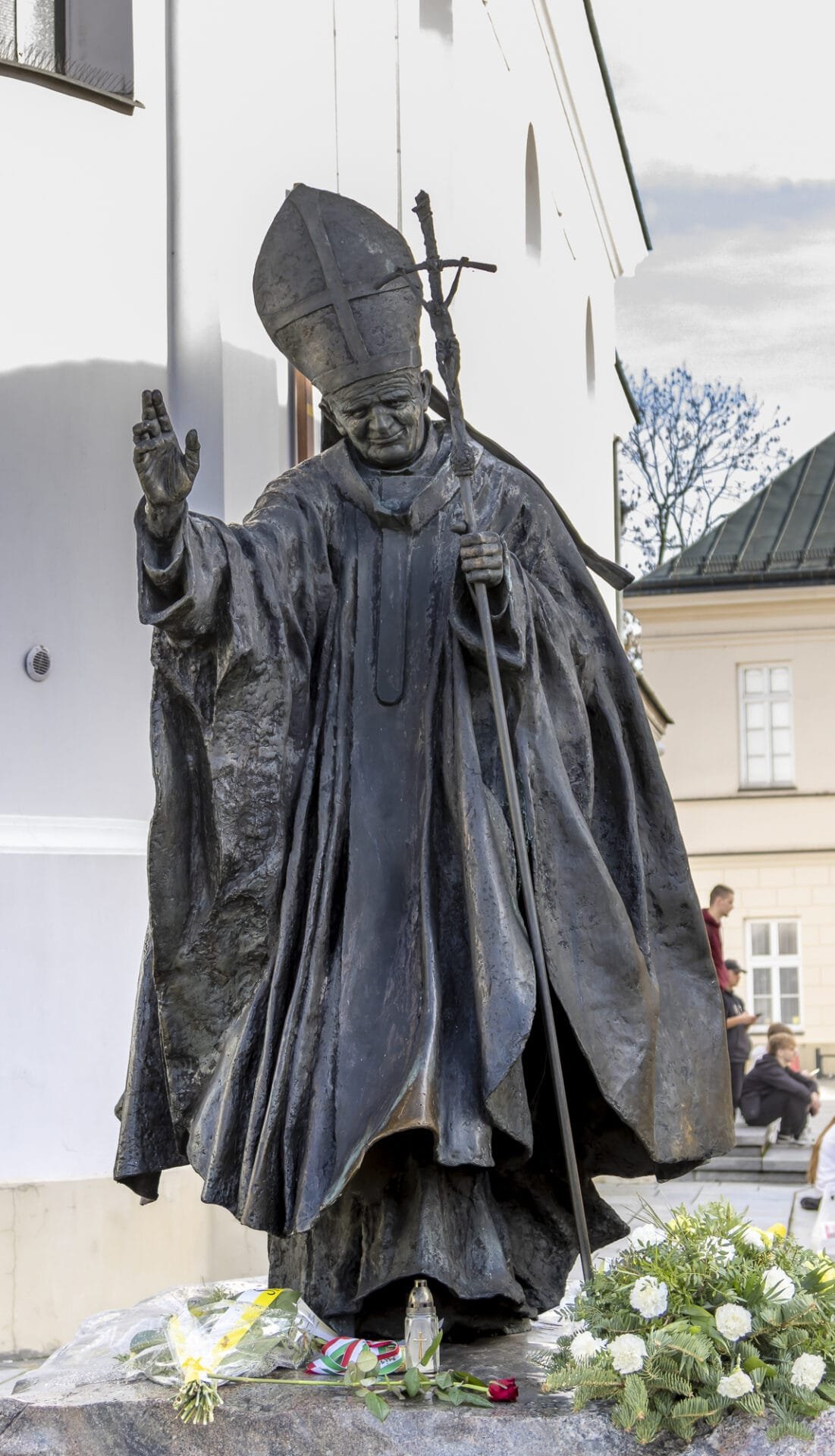
The men in the image are members of the Order of the Knights of Pope John Paul II. The Order was founded in 2011 as a token of gratitude for the pontificate of St. John Paul II. Members, dressed in distinctive black cloaks with yellow trim (the papal colors), participate in religious ceremonies and commemorations, such as the anniversary of the Pope’s death or birth, to honor his memory and follow his example. We were fortunate enough to witness their wreath-laying ceeremony, laying a wreath of flowers at the base of the statue of John Paul II located in the square.


This wraps up our visit to Wadowice, home of Pope John Paul II. We now head back to Krakow to visit the Sanctuary of John Paul II and the Sanctuary of Divine Mercy.
Mark


Leave a Reply