We begin our 5th day in Torun. Old-Town Torun is another UNESCO World Heritage site. But, more on that in an other post.
As with some previous posts, some of the places shown were identified using Gemini and translations were provided by Google Translate.
Gingerbread
Torun is known for its gingerbread where it has been produced since the Middle Ages. The first mentions of gingerbread in Torun date back to the 13th century. By the 18th and 19th centuries Torun gingerbread went into mass production. The largest gingerbread factory was opened in 1751 and operated until 1945, when it was nationalized and turned into the now, world-famous Kopernik Confectionary Factory. The original factory is now a store selling gingerbread. [REFERENCE]

Why gingerbread in Torun? Torun was in an excellent location, surrounded by high-quality soil providing fine wheat for flour, while nearby villages provided honey. The necessary spices were brought from India, via a route through the Black Sea to the Holy Roman Empire, then transported by north-German trade companies. Some also came by sea to the port of Gdańsk. [REFERENCE]
It’s the Katarzynka gingerbread shape that has the most endearing local legend. “Katarzynka,” is Polish for “little Catherine.” According to the story told in Torun, there was once a little girl who wanted to bake gingerbread for her sick father. She didn’t have the right cookie cutter on hand, so she used a cup to cut the dough pieces. However, because she placed the dough circles too close together on her baking pan, they baked together into what looks like a cloud shaped cookie. From then on, this shape of Toruń gingerbread became known as the “Katarzynka,” after the girl’s name. You can see this shape outlined in the window of the factory store. [REFERENCE]

Carefully protected recipes that call for the use of only the highest quality ingredients as well as specific techniques for kneading and aging the dough. Although today’s recipes are kept secret, I found an old 18th century recipe on line. I’m glad I don’t have to follow this recipe for my gingerbread.
“Take as much as you want of unleavened honey, put it to a vessel, add a goodly amount of strong booze and water, fry it slowly skimming it at times until it is thick, pour it to a pan, add white ginger, cinnamon, cloves, nutmeg, cubeb (a type of peppercorn), cardamom, non-crushed anise, fine cut lemon rind, as much sugar as you wish and crush it all roughly. Add to the hot honey, however, with not some much spice, mix it all together and when the honey cools down add enough rye flour, mix and let it wait covered until it is cool, then put it on the table and knead it as hard as possible adding as much flour as you need, then add cut candied orange peel or lemon rind fried in sugar, knead again and form gingerbread as you like it. You can put some candied orange on the top here and there and sprinkle with beer and put into the oven for some time, then spread some more honey with fried beer on the top and put to the oven again.” [REFERENCE]
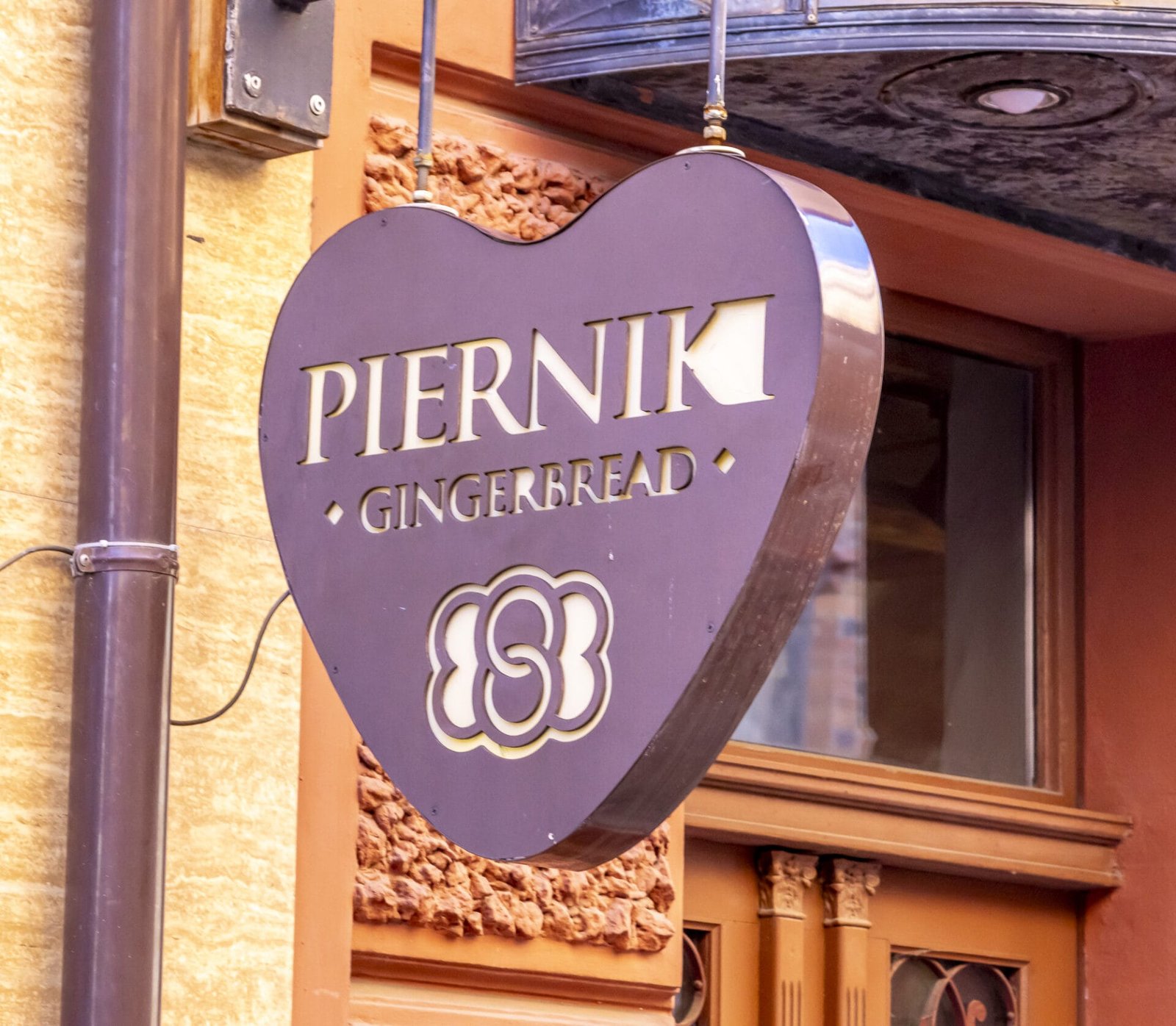
Today, as you wander around Torun, you can find pierniki shops scattered around Old-Town.


As stated above, local honey is used in gingerbread. This store, who’s name translates to Bee Miracles, sells honey and other bee products.

Copernicus
On February 19, 1473, Nicolaus Copernicus is born in Torun. Copernicus is known as the father of modern astronomy as he was the first modern European scientist to propose that Earth and other planets revolve around the sun.

Note that Copurnicus is holding an armillary sphere, also known as an astrolabe, a symbol representing his heliocentric theory that the Earth and planets revolve around the Sun, challenging the widely held belief that the Earth was the center of the universe. His right index finger points to the heavens. [REFERENCE]

As mentioned above, Copernicus was born in Torun. His father was a merchant from Krakow and his mother was the daughter of a wealthy Torun merchant. Nicolaus was the youngest of four children. Copernicus never married and is not known to have had children. [REFERENCE] Here is the home where was born.

This plaque describes the house in more detail.

Churches of Old-Town Torun
As we look around Old-Town we can see the spires and towers of multiple churches. Here is the Church of the Holy Spirit.


Just around the corner stands the 14th century brick Gothic St. Mary’s Church, also known as Church of the Assumption of the Blessed Virgin Mary. In the 14th century, it was considered the tallest church in Central Europe at 88 feet.


This view represents three possible stages in one’s life. In the center is part of the Nicolaus Copernicus University. To the left is the “Okrąglak” building, which is a unique, circular prison. And on the right is the corner of St. Mary’s Church.

This is the facade of the Church of St. John the Baptist and St. John the Evangelist, commonly known as St. John’s Cathedral. It received its present-day shape as a result of the multi-stage construction which was interrupted at the turn of the 16th century, after 200 years of work.

Text around the seal, including “JOANNES PAULUS II 1992” and “DIOECESIM THORUNIENSEM EREXIT”, refers to Pope John Paul II’s establishment of the Diocese of Toruń in 1992.

The image shows the unique, one-handed clock face on the tower of St. John Church. It is known as the “Digitus Dei” (God’s Finger) or “Rafters’ Clock” due to its location near the Sailor’s Gate. The clock is a medieval, single-hand clock, meaning it only has an hour hand to indicate the time. It is one of the oldest clocks in Europe, dating back to the late 14th century. [REFERENCE]

Here is a detailed view of the clock.

Old Town Hall of Torun
The old Town Hall in Torun was historically used as the center for patrician cultural life and the meeting place for merchant guilds. Note the date of 1311 on the left tower. The date on the right tower likely represents a date of renovation.

The Torun Coat of Arms is located high on the Town Hall. It shows an angel holding a key to the city (welcoming visitors) and a gate with three towers. The gate is a door, which is half-open, and half-closed indicating that the city is closed to cruel enemies, but open to guests. [REFERENCE]


Around the side of the Town Hall is the courtyard entrance.

Again we see the Torun coat of arms above the entrance.

As we enter the courtyard, I noticed several small sculptures perched on window ledges. They represent local residents of Torun. This one shows the legendary Toruń raftsman who, according to folklore, saved the city from a plague of frogs by playing his violin. I’ll have more on him later in this post.


Legends and Stories from Torun
There are a number of legends describing some of the sights in Torun.
This marker of a cat above the entrance to this pirogi shop has two legends attached to it. These are taken verbatim from this reference.
Tin Cat on the Roof
“While strolling through Torun’s Old Town Square, stop for a moment at tenement house no. 8 and look up. You’ll see a tin cat on its roof. Legend has it that many years ago, Józek lived in this tenement house with his cat. They shared a true human-cat friendship. They spent every moment together. The cat was his master’s faithful companion, and Józek cared deeply for his friend. Unfortunately, when war broke out, Józek was called up to defend the country and had to leave his faithful companion. The cat, sorely missed, climbed the roof of the tenement house where they lived every day, waiting for Józek’s return. However, he was not destined to live to see him. Józek died in combat and never returned. Despite everything, the cat waited patiently. Even on the hottest days, he stood on the roof to check if his master was returning. On one such day, his paws glued to the heated roof, and he remained forever in the spot where he could see the most.”
The Cat who Defended Torun
“Another legend tells of cats tasked with freeing Torun from a plague of mice that had plagued the city years before. Most of the four-legged creatures performed their task quite well. However, one of them had no intention of participating in the rodent-catching operation. Instead, he preferred to lounge on the city’s defensive walls, which became his favorite vantage point. Everything changed in February 1629. Then, the city was invaded by Swedish troops. The gray cat, resting on the defensive walls, observed everything. This situation awakened his fighting spirit. The cat bravely defended the city against the invaders. His teeth and claws inflicted numerous wounds on the Swedish soldiers, and the two-day defense of the city ended in success.
“Word of the heroic cat quickly spread throughout the area. The people of Torun, wanting to thank the cat for his services, prepared a warm bed for him, alongside which bowls of delicious treats were always placed. Furthermore, in memory of his achievements, the defensive structures located near the Chełmno Gate were named after the cat. Four towers were called Cat Paws, the tower at one end was named Cat Tail, and the one at the other, Cat Head. The Barbican was named Cat Belly. Unfortunately, only the Cat Head remains to this day.”

Our next legend is about the plague of frogs and the raftsman and comes from this reference.
“The frogs were once everywhere: in the bedding, wardrobes, attics and caused great discomfort to the citizens of Torun. The mayor, trying to face the frog problem, announced that the person who would free the town from the huge number of frogs would receive a generous award. There were many daredevils. Some tried to chase the frogs away, some put them in bags and took them outside town, however, none of them succeeded. One day a young rafter started playing rafter melodies on the violin being terribly out of tune. The frogs liked the strange music so much that they started to gather around the young man. The rafter, still playing the violin, led the frogs out of the town where there were swamps and ponds. There is now a statue of the legendary rafter playing the violin and eight listening frogs around him. One needs to stroke them gently and think of a wish and it will surely come true.”


This monument is a replica of a wooden donkey with a sharp metal back used as an instrument of punishment in the 17th and 18th centuries. The Spanish Donkey, also known as the Torun Donkey, with a sharp ridge on its back, was used to discipline insubordinate soldiers in the 17th and 18th centuries. Lead weights were tied to their legs while seated on its back, intensifying the punishment. [REFERENCE]

More Around Torun
These photos from Old-Town Torun didn’t fit with the topics above, so I will conclude this post with other views I found interesting.
This building is known as the Rosner House. Originally two tenement houses, it served as a branch of the National Development Bank.

As we step into the Market Square, we see this massive Main Post Office building.

This is a tribute to Zbigniew Lengren, a Polish cartoonist, caricaturist, and illustrator. He was awarded the “Order of Smile ” and other awards. His most famous creation is Professor Filutek, who appeared once a week on the last page of Przekrój magazine, together with his dog Filuś, for over 50 years, a record run in Polish comics. [REFERENCE]

The rest are just things that caught my eye.


This was a long post, so I thank you again for following along. As we leave Torun, we still have a lot of daylight. We now head to the birthplace of Saint Faustina.
Mark


Leave a Reply