After spending the night in Gdansk, we headed to the resort town of Sopot on the Baltic Sea. The spa resort boasts naturally occurring mineral spring waters which are rich in chlorides, iodides and bromides.
The history of Sopot dates back to the Napoleonic times. In 1808, Dr Jan Jerzy Haffner settled here and on the suggestion of the Prussian government, built and launched a therapeutic bathing facility. At this time Sopot was gaining popularity as a summer seaside holiday destination. [REFERENCE]

As a resort town, many wealthy families built ornate homes in Sopot. This is just an example.


This modernized apartment hotel is housed in a 100-year-old tenement building and fits right in with the resort feel of Sopot.

As we approach Bohaterów Monte Cassino, the main pedestrian mall in Sopot, we catch glimpses of the Garrison Church of St. George. The church’s construction was completed in 1901 and was originally an evangelical church. After WW II, it was transferred to the Catholic church. [REFERENCE]


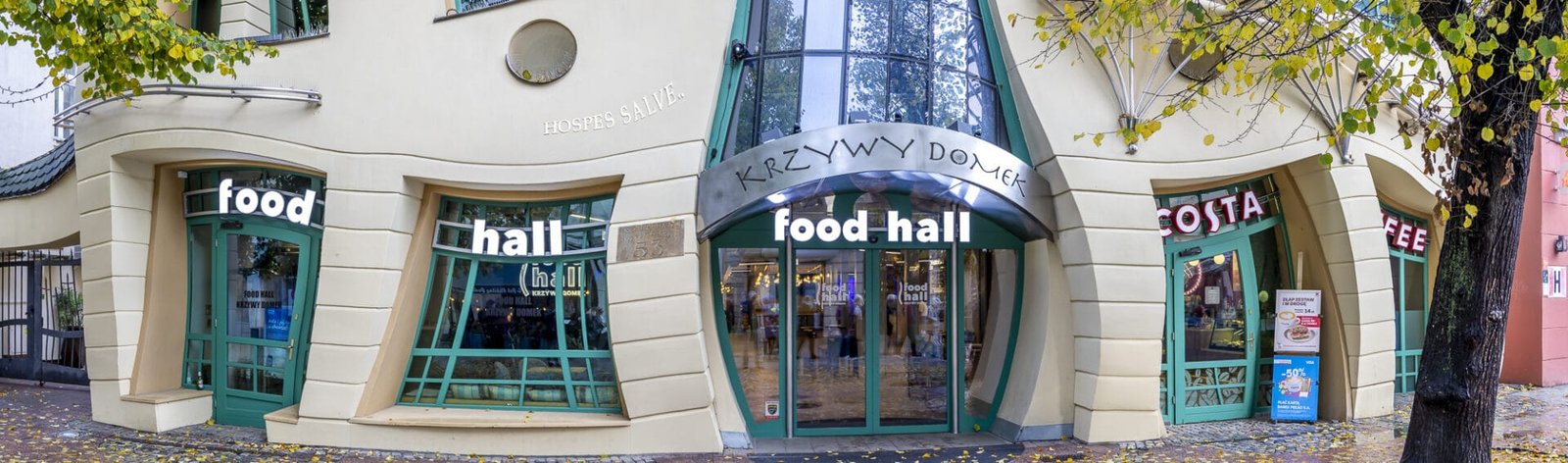
Continuing down Bohaterów Monte Cassino, we find this interesting building, The Crooked House.
The building’s whimsical and surreal appearance was inspired by the fairytale illustrations and drawings of Polish illustrator Jan Marcin Szancer and Swedish artist Per Dahlberg.

This African fisherman carrying a net and fish is suspended above the street on a tightrope and seems to defy gravity. It’s the work of Polish sculptor Jerzy Kedziora who specializes in these balancing sculptures. [REFERENCE]


This manhole cover displays the Sopot coat of arms, which features a seagull with a fish in its beak over a wavy line representing the sea, and a crown above it.

The taller tower is the Sopot Lighthouse.

This is the Balneological Institute, an organization dedicated to the scientific study of balneology, the therapeutic use of mineral and thermal waters, mud, and gases.

The sculpture above the entrance features a mermaid and a merman on either side of the coat of arms of the city of Sopot. The mermaid and merman are local symbols representing the city’s strong connection to the sea and its historical function as a renowned seaside health and spa resort. There is an inscription (not visible in this photo) of the city’s motto “Nec temere, nec timide” (Neither rashly nor timidly).

This plaque commemorates the Pope John Paul II pastoral visit to the city of Sopot in June 1999. The Polish inscription on the plaque translates to “There is no solidarity without love”. The relief depicts a bust of the Pope with his hands resting on a railing, with a stylized image of the Sopot pier and the coastline in the background.

Sopot is also known for its pier. It was built as a pleasure pier and as a mooring point for cruise boats. It first opened in 1827, and at 511.5 meters (1,678 ft), the pier is the longest wooden pier in Europe. It is said that the concentration of iodine in the air at the tip of the pier is twice as high as on land, considered a healthy benefit. [REFERENCE]
Standing on the pier and looking back toward town we can see the Sopot Spa House. There is also a carousal and other tourist attractions.
About half way to the end of the pier is the Meridian Club Restaurant. Although the restaurant offers wonderful views of the pier, the sea, and Sopot, the day we were there was not a great day to sit outdoors and enjoy and view.

It was very windy and cold.


At the end of the pier is this yellow post covered in stickers. The chain in front of the post contains several “love locks“.

Looking back to shore we see the large expanse of the Grand Hotel. The hotel was originally built in 1924–1927 and was the most refined hotel in Sopot. The hotel served as Adolf Hitler’s headquarters in 1939 from which he went twice to the outskirts of Warsaw to oversee the invasion of the city. Since then, it has had a long list of famous visitors. In 1990, the hotel launched a casino, the third in Poland after Warsaw and Krakow. It has undergone several renovations and is being further restored today. [REFERENCE]


As I mentioned above, it was a cold, windy day. However, if you could find a spot out of the wind and the sun came out, it was quite nice, as Agnes, our tour director shows.

This monument is dedicated to Jan Jerzy Haffner (1775-1830), the founder of the Sopot health resort, the first professional bathing establishment and a spa house, leading to the town’s development as a famous resort in 1823. [REFERENCE] It included a bathhouse, a spa hotel, changing rooms, a seaside park, and the first wooden pier.


This ends our tour of Sopot. It was good to get out of the wind and back onto our warm bus. From here we head back to Gdansk.
Mark


Leave a Reply