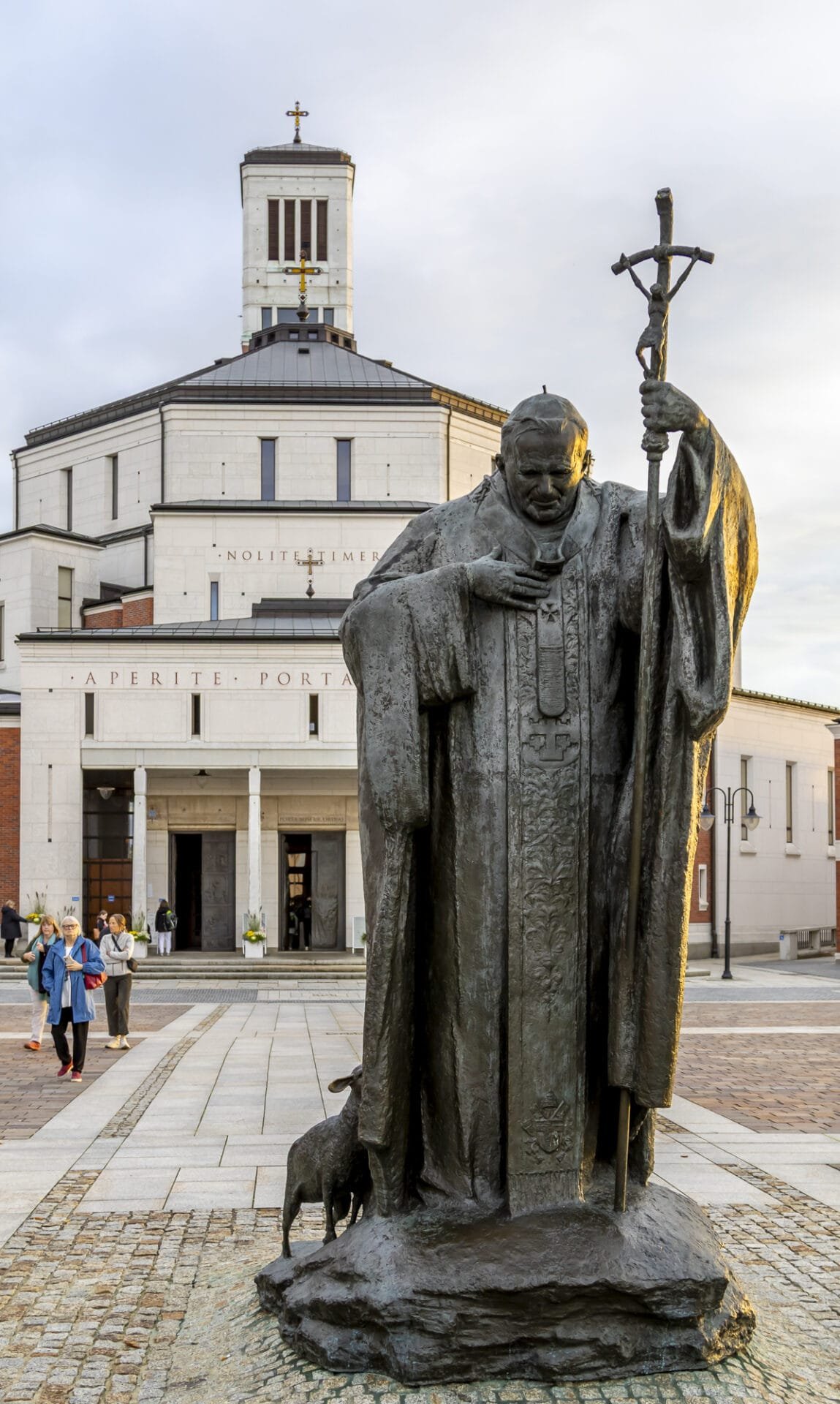
The Sanctuary of St. John Paul II near Kraków, is a modern pilgrimage site dedicated to the Polish Pope. Completed around 2016, the complex features a two-level church with many colorful mosaics and more. The Upper Church is a modern space with a large dome and vibrant mosaics covering the walls which depict the life of John Paul II. The Lower Church is the Church of Relics, an octagonal, chapel containing a marble altar with a vial of the saint’s blood. The sanctuary is located on the site of the former “Solvay” factory area where Karol Wojtyła (the future Pope) worked during WWII.
Information for this post has come from several references [REFERENCE 1, REFERENCE 2, REFERENCE 3]. Some information has been provided through AI (Gemini). All translations were done with Google Translate.


The text on the sanctuary is “NOLITE TIMERE” (“Be not afraid”) and “APERITE PORTAS CHRISTO” (“Open the doors to Christ”).

The upper church of the sanctuary is full of beautiful mosaics. This is the main altar of the Upper Church. The large central mosaic depicts the Nativity of Jesus Christ (middle section) and the Ascension or Christ in Glory (top and bottom sections).


This mosaic is of Our Lady of Guadalupe, the patron saint of Mexico and “Patroness of the Americas” with images of St. Peter’s Basilica in Rome and another church I couldn’t identify.


This mosaic, titled “Złota Jerozolima” (Golden Jerusalem), depicts a scene of heavenly worship centered on Jesus Christ, represented in the center as the Paschal Lamb. On either side of the Lamb are the Virgin Mary and St. John the Baptist. The mosaic also shows prominent Polish and international saints, including St. Stanisław, St. Adalbert (Wojciech), St. Faustina Kowalska, and Padre Pio. Water flowing from beneath the Lamb represents the sacred liturgy, connecting the heavenly community (those in Glory) with the earthly community (those in history).


As a side note, the choir shown above was practicing. Here is a short video of their rehearsal.

The image is a mosaic panel depicting the Pietà, depicts the body of Jesus Christ held by his mother, Mary, after the Crucifixion.

We move to the lower church to find the Chapel of St. Kinga, the Hungarian princess who became a Polish queen and is the patron saint of Poland and Lithuania. Kinga was canonized by Pope John Paul II in 1999. Remember Saint Kinga from our visit to the Wieliczka Salt Mine? All the artwork in this chapel is made of salt, including replicas of some of the relief sculptures in the St. Kinga Chapel in the salt mine.


We move on to the Chapel of Our Lady of Loreto. This title of Mary refers to the house in which she was born and raised, and in which the angel Gabriel visited her in the Annunciation. Tradition holds that angels miraculously transported the house from Palestine to Loreto, Italy, in the 13th century. For more on this, see here.
This image shows the Oratory of Our Lady of Loreto. At the center is a statue of Our Lady of Loreto (the Black Madonna) holding the Infant Jesus. Above the altar on the archway is the Latin phrase “HIC VERBUM CARO FACTUM EST,” which translates to “Here the Word was made flesh”. This inscription is significant as it traditionally marks the spot of the Annunciation in the original Holy House of Loreto.

This mosaic, featuring Saint Pope John Paul II in his liturgical vestments, holding a papal staff. Below the Pope are mosaics of other beatified or canonized individuals, including several martyrs. A white dove, representing the Holy Spirit or peace, is visible at the top, while a hot air balloon with the text “EurHope” appears on the right.

Pope John Paul II is featured on the right, holding a staff. The chapel background depicts an altar, likely referring to the Holy House of Loreto, for which the chapel is named. Figures in wheelchairs on the left and various flags (like the flag of Iran in the top right) symbolize his ministry to the sick and his extensive world travels.

This chapel is dedicated to Saint Queen Jadwiga, the first female monarch of the Kingdom of Poland.

This chapel shows a reproduction of the painting of Our Lady of Piekary (also known as the Mother of Social Justice and Love).

This is The Church of the Relics, the central chapel in the heart of the Lower Church. It houses a marble altar containing a vial of Saint John Paul II’s blood. The walls are decorated with beautiful mosaics depicting scenes from the life and pontificate of Saint John Paul II, as well as his devotion to the Virgin Mary. This area contains the original tomb slab that covered John Paul II’s grave in the Vatican Grottos before his beatification.

The large marble slab in the foreground is the original slab from the tomb of Pope John Paul II in the crypt of St. Peter’s Basilica. After his beatification in 2011, his remains were moved to the main floor of St. Peter’s, and the original slab was gifted to this sanctuary. Resting on the slab is a sculpted representation of the Book of the Gospels. It commemorates the moment during the Pope’s funeral Mass when the wind turned the pages of the Gospels placed on his coffin. The sculpted book contains a vial of the saint’s blood.


This detail from behind the marble slab shows an image of Our Lady of Calvary. We saw the original in Our Lady of the Angels Basilica, shown in an earlier post. The icon held deep personal significance for Pope John Paul II. After his mother’s death, his father took him to this painting and told him, “Now, this is your mother”.

This image depicts a copy of the Salus Populi Romani (Health of the Roman People) icon, located within the Marian Chapel (also known as the American Chapel or Chapel of the Pope’s Patrons). The central image is a venerated icon of the Blessed Virgin Mary and the Child Jesus. Traditionally attributed to St. Luke the Evangelist, the original resides in the Basilica of Saint Mary Major in Rome. Above the icon, the Latin inscription reads: “SALUS POPULI ROMANI ET ROMANI PONTIFI” (Health of the Roman People and of the Roman Pontiff).


This mosaic artwork, titled Mater Ecclesiae (Mother of the Church), depicts Pope Saint John Paul II in prayer alongside an icon of the Virgin Mary and the Child Jesus.

This mosaic depicts Our Lady of Perpetual Help (also known as Our Mother of Perpetual Help or Our Lady of Perpetual Succour) being venerated by Pope John Paul II.

This mosaic, titled the Croatian Oratorium, is a tribute to the deep bond between the Polish and Croatian nations, both of which were deeply cherished by Pope John Paul II. The mosaic depicts three figures: St. John Paul II (bottom), Our Lady of Marija Bistrica (top right, a representation of the Virgin Mary with the Child Jesus from Croatia’s national Marian sanctuary, Marija Bistrica), and Blessed Cardinal Alojzije Stepinac (top left, a prominent Croatian prelate whom John Paul II beatified in 1998).

This mural, part of the Church of the Relics features Pope Saint John Paul II as the central figure, surrounded by various saints and historical figures associated with his life, Poland, or his papacy.

Our next stop will be the Sanctuary of Divine Mercy, just a short walk from here.
Mark


Leave a Reply