The shrine of Our Lady of the Angels is part of a large complex, Kalwaria Zebrzydowska, that includes a Franciscan monastery and 42 chapels spread across about 1500 acres. The shrine of Kalwaria Zebrzydowska is one of the most often visited pilgrimage sites in Poland with more than a million pilgrims every year. The Shrine has a twofold purpose. Firstly, the shrine is dedicated to reflection on the Passion and Death of our Lord, Jesus Christ. In fact, the most frequented event is the celebration of the Holy Week liturgies at Kalwaria Zebrzydowska. The second purpose is reflection on the dormition and triumph of Our Lady.
Much of the information presented in this post comes from the following references, [REFERENCE 1], [REFERENCE 2], [REFERENCE 3], [REFERENCE 4]. Translations were performed using Google Translate. Some information also comes using AI (Gemini).
As to the first purpose, Kalwaria Zebrzydowska was designed as a literal mathematical and topographical “copy” of Jerusalem. When the Ottoman Turks recaptured the Holy Land in the early 1500s, making it difficult for Europeans to travel there, there was a desire to create a place where people could experience the actual physical “feel” of the Holy City without leaving Poland. The founder, Mikołaj Zebrzydowski, hired a mathematician and astronomer named Feliks Żebrowski to survey the land. Using a map of Jerusalem from 1584 as a guide, Żebrowski measured the distances between sacred sites in the Holy Land and applied them to the Polish hills. Although the Polish version is on a larger scale (the walks are longer), the proportions between the “stations” remain consistent with the original city’s layout. To complete the immersion, the natural features of the Beskidy mountains were renamed to match Jerusalem’s landmarks. The Żar Mountain became Golgotha and the Lanckorona Mountain became the Mount of Olives, for example. The 42 chapels on the site aren’t identical to what you’d find in Jerusalem, but their shapes and placements are symbolic. For example, the House of Caiaphas is built on an elliptical plan to suggest a courtyard. Many of these buildings actually contain soil brought back from Jerusalem, physically linking the two locations. The terrain was chosen because it mimics the physical terrain of the original Way of the Cross. For example, the path from the “Third Fall” to the “Crucifixion” is a steep uphill climb. Pilgrims aren’t just looking at art; they are physically exhausted by the ascent, which is intended to help them empathize with the suffering of Jesus. Thus Kalwaria Zebrzydowskais said to be a specific copy of Jerusalem’s Via Dolorosa with its chapels established to reflect upon the Passion of Christ and on Our Lady’s Life. Amazing!
This map shows Our Lady of the Angels Basilica, in the upper left corner, and the route pilgrims can follow as if on the Via Dolorosa. The path is over 5 miles long. Unfortunately, our stop did not include the opportunity to follow this pilgrimage route, but focused only on Our Lady of the Angels Basilica.

Our Lady of the Angels Basilica is the centerpiece of this large complex. It was built between 1603 and 1609. Our Lady of Calvary is a 17th-century painting situated in the basilica. According to legend, the painting wept in 1641. The owner presented the painting to the monastery at Kalwaria Zebrzydowska. Veneration of the painting was authorized fifteen years later, and a chapel was commissioned to house it. The painting was canonically crowned by Pope Leo XIII on 15 August 1887. Today it is housed in Our Lady of the Angels Basilica.
For Pope John Paul II, this shrine was a lifelong spiritual anchor. His family’s connection spanned generations; both his father and grandfather served as pilgrim guides there. Following his mother’s death, his father brought him to the sanctuary, sparking a devotion that persisted through his years as a priest, Archbishop, and Cardinal. During his Papal visits in 1979 and 2002, he celebrated the shrine’s 400th anniversary. In a moving final prayer, he entrusted the Church, the unemployed, families, and his own failing health to Mary.
“Turn then, most gracious advocate, thine eyes of mercy towards us, and after this our exile, show unto us the blessed fruit of thy womb, Jesus”. “Turn, Lady of all graces, your gaze and look upon these people which for centuries have remained faithful to you and to your Son. Look upon this nation, which has always placed its hope in your maternal love. Turn the gaze of your eyes of mercy towards us, and obtain what your children most need. Open the hearts of the prosperous to the needs of the poor and the suffering. Enable the unemployed to find an employer. Help those who are poverty-stricken to find a home. Grant families the love which makes it possible to surmount all difficulties. Show young people the way and a horizon for the future. Cover children with the mantle of your protection, lest they be scandalized. Confirm religious communities with the grace of faith, hope and love. Grant that priests may follow in the footsteps of your Son, by offering their lives each day for the sheep. Obtain for Bishops the light of the Holy Spirit, so that they may guide the Church to the gates of your Son’s Kingdom by a single, straight path”. “Most Holy Mother, our Lady of Calvary, obtain also for me strength in body and spirit, that I may carry out to the end the mission given me by the Risen Lord. To you, I give back all the fruits of my life and my ministries. To you, I entrust the future of the Church; to you I offer my nation; in you do I trust and once more I declare: Totus Tuus, Maria! Totus Tuus! Amen”.
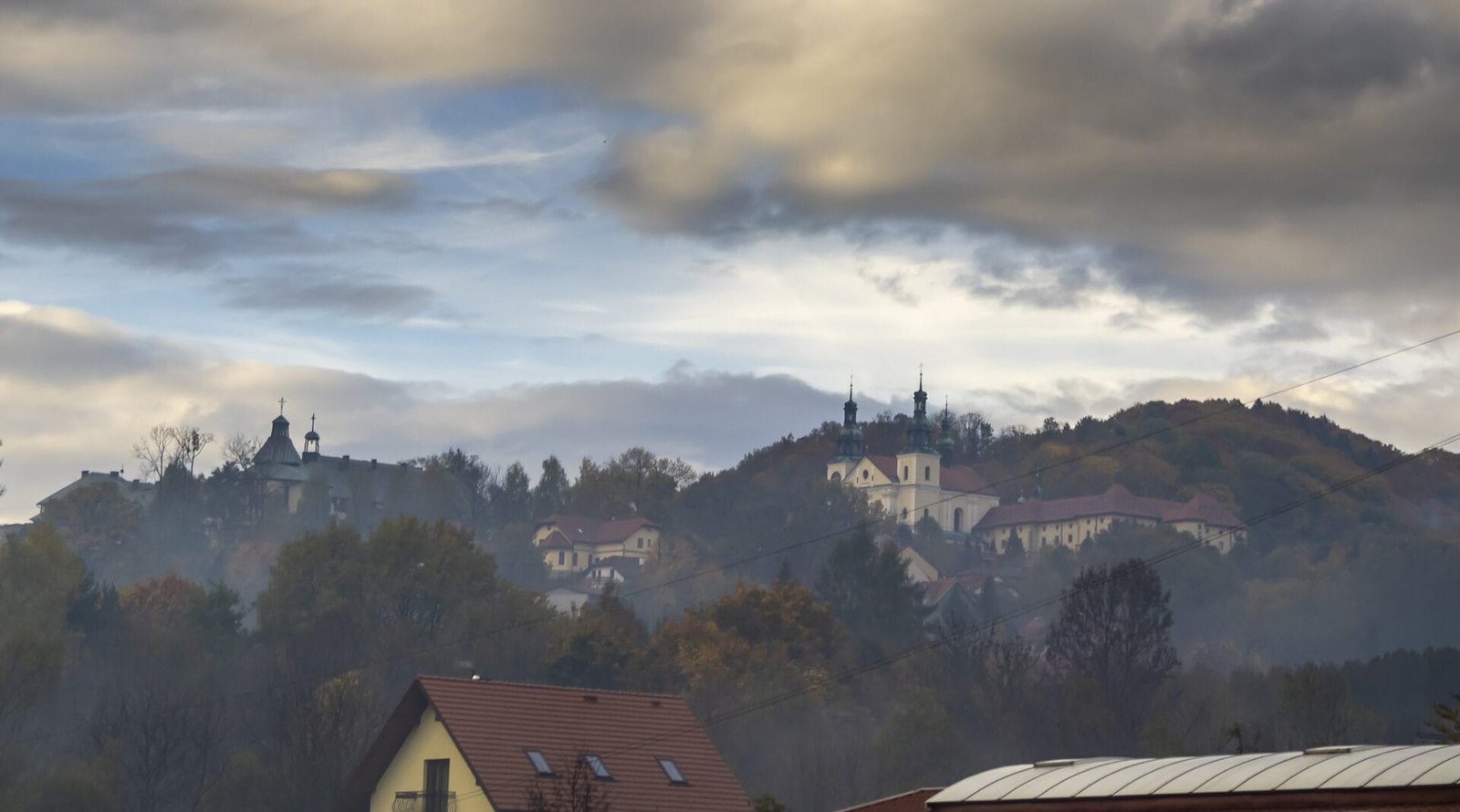
Our Lady of the Angels Basilica is beautifully situated in the hills, visible from the bus as we approached.

The fence in front of the basilica is lined with statues. I’ll show those in more detail below.

A statue of Pope John Paul II looks out over the valley below the basilica.


One of the 42 chapels Kalwaria Zebrzydowska is in front of the Basilica, Chapel of St. Raphael.

The fence in front of the Basilica is lined with other statues. I could not identify many of them, but have provided my best estimate of their identity. If you know a better identity, or can confirm the identity of these, please let me know in the comments.

This statue may be Saint Roch, the patron saint of dogs, bachelors, and the plague.


Other statues in front of the Basilica are shown below.
The Virgin Mary is portrayed as Queen of Heaven holding a scepter as a symbol of her regal authority. The pose with the right hand raised in a blessing gesture further emphasizes a position of authority and intercession.


This statue is of Mary. The text “MARVJO KROLOVD POLSKI” translates to “Mary, Queen of Poland”.

Saint Francis of Assisi. The text “PAX ET BONUM” translates from Latin to “Peace and Good,” a common Franciscan greeting.

Once we enter the basilica, we are greeted with this beautiful setting. This side altar of Our Lady of the Angels Basilica is focused on the Crucifixion. The altar was created around the year 1700 in a typical Baroque style. The altar highlights a dramatic depiction of the Crucifixion of Christ, set against an ornate, silver-plated background adorned with angels and a relief panorama of the local landscape.

The image of the pelican is in the lower part of the alter. The pelican, depicted in dark metal, is a traditional Christian symbol of the Eucharist and Christ’s sacrifice. The text “CORPUS CHRISTI” (Latin for “Body of Christ”) is visible vertically to the right of the pelican. The scene also includes depictions of wheat and grapes, representing the bread and wine of the Eucharist. The symbolism of the pelican was described in my post from Malbork Castle.

This is the main alter in Our Lady of the Angels Basilica. The oval-shaped, highly decorated center of the altar houses a silver sculpture of Our Lady of the Angels, which was originally bought from Loreto, Italy.


This is the alter of Our Lady of Calvary, named for the icon of Our Lady and the Infant Jesus. The icon is a 17th-century painting that, according to legend, wept bloody tears in 1641. It depicts Mary holding the Child Jesus, both wearing crowns. This sanctuary was a frequent place of prayer for Pope Saint John Paul II, who was born in the nearby town of Wadowice.
The Polish text visible on the altar frontal and above the icon includes parts of traditional Catholic prayers and titles for the Virgin Mary. Above the icon we see “POD TWOJĄ OBRONĘ” the title of the ancient Christian prayer (antiphon) Sub tuum praesidium (Under Your Protection). The embroidered text on the altar cloth includes variations of titles and supplications “KRULUNU KUZANCA SHIL TELU JEDYNA NADZIE JO CZŁOWIEKA GRZESZN,” which translates roughly to “Queen of the Rosary… only hope of sinful man”.

The faces and hands of the icon are painted on a wood panel, while the garments are covered with elaborate gold leaf and precious votive offerings of jewels and pearls, which is a common practice for highly venerated icons. This is just one of the many ornate “robes” or sukienki that dress the icon. Remember The Black Madonna also had several “dresses” to adorn the icon.


There were many other paintings and small altars in the basilica that I will show here without much commentary.


Before we left the basilica, we posed for a group photo.

Our next stop will be Wodowice, the home of Pope John Paul II.
Thanks again for following along with these long posts.
Mark


Leave a Reply