We continue to explore Krakow. As I mentioned in the previous post, Krakow has a long history and its Old-Town is listed as a UNESCO World Heritage Site. Although St. Mary’s Basilica is a dominant feature in Old-Town, there is much more to see.
I have relied on several references scattered through this post for most historical information. All translations have been performed using Google Translate. A few identifications were done using AI (Gemini).
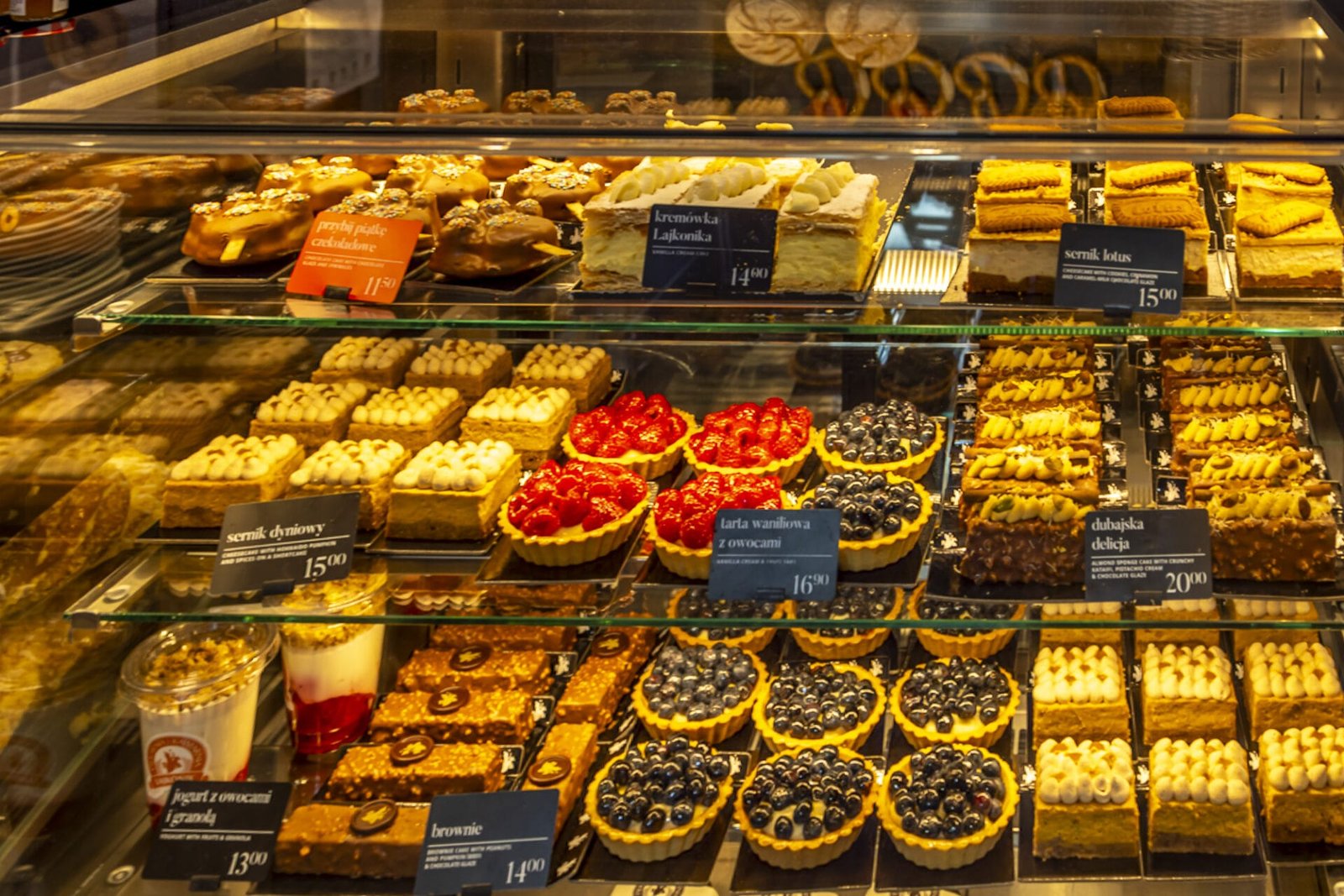
The first order of business was to find lunch. We wanted something grab-and-go so we would have more time to explore. Thank you, Agnes, for the suggestion of Lajkonik Bakery and Cafe. They had a wonderful selection of breads, sweets, and prepared sandwiches.

Krakow Main Market Square
Now that our appetites have been cared for, we set off to explore Old-Town Market. The main market square is one of the largest in Europe and dates back to the 13th century [REFERENCE]. The tower shown below is the Town Hall Tower. The Tower is the only remaining part of the old Kraków Town Hall demolished in 1820 as part of the city plan to open up the Main Square. Its cellars once housed a city prison with a Medieval torture chamber [REFERENCE].

One of the prominent features of the square is the Old Cloth Hall. This hall was once a major center of international trade. Traveling merchants met there to discuss business and to barter. During its golden age in the 15th century, the hall was the source of a variety of exotic imports from the east – spices, silk, leather and wax – while Krakow itself exported textiles, lead, and salt from the Wieliczka Salt Mine. [REFERENCE]

Today, Cloth Hall is a marketplace with stalls selling a wide variety of Polish pottery, clothing, amber, jewelry, and many other items.

The Adam Mickiewicz Monument stands in the center of the Main Market Square. The monument is a memorial to Adam Mickiewicz (1798-1855), considered the greatest Polish Romantic poet. The main statue of Mickiewicz stands atop a large pedestal, surrounded by four allegorical figures at its base, symbolizing Science, the Motherland, Poetry, and Courage.


The statue below is the Żak Fountain (also known as the Monument of an Abecedarian) located in a Square adjacent St. Mary’s Basilica. The figure is called a “żak” or “abecedarian,” which is a medieval term for a novice or a student learning the alphabet. According to local legend, throwing a coin into the fountain ensures that you will return to Krakow in the future. (I wish I had know that when I was there!)

The following photos are some of the scenes from wandering around Old-Town.
Old-Town Churches
There are more than a dozen churches in Old-Town. We visited St. Mary’s Basilica in the previous post. Now we only have time to walk past some of the others. Here is the Church of the Holy Trinity.


Walking Through Old-Town
The Antoni Suski House is a historic tenement house with the statue of the Virgin Mary. The ground floor now houses a McDonalds.


This wooden door is an entry to the Florian Mokrski Palace. The letters “K+M+B” and the year “2029” are a traditional chalk inscription associated with the feast of the Epiphany. The inscription “K+M+B” indicates a blessing on this house. The letters stand for the traditional names of the three Magi who visited the infant Jesus, Kacper (Caspar), Melchior, and Balthazar. The letters are also an abbreviation for the Latin phrase “Christus mansionem benedicat”, which translates to “May Christ bless this house”. This chalking tradition typically occurs on or after the Feast of the Epiphany (January 6th) and is a request for God’s blessing and protection against illness and misfortune for the household throughout the new year. The number “2029” indicates the year the blessing was applied.

This is the building where Karol Wojtyła, who later became Pope John Paul II, lived in Kraków. The sign translates to “Fr. Karol Wojtyła, later Pope John Paul II, lived here between 1951 and 1967”.

The inscription on this doorway, “NIL EST IN HOMINE BONA MENTE MELIVS”, translates to “There is nothing better in a man than a good mind”. It is located at Pontifical University of John Paul II in Kraków. Notice also the 2025 blessing on this door.

Wawel Hill and Wawel Castle
Wawel Castle is a fortified residency established on the orders of King Casimir III the Great who ruled in the 1300s. It has been renovated and added to over the years and now represents nearly all European architectural styles of the Medieval, Renaissance, and Baroque periods.
The castle sits atop a a hill in Old-Town. The complex consists of numerous buildings of great historical and national importance, including the Wawel Cathedral where Polish monarchs were crowned and buried. Some of Wawel’s oldest stone buildings can be traced back to 970 CE. For centuries it was the residence of the kings of Poland and the symbol of Polish statehood. Now, Wawel Castle is one of the country’s premier art museums. [REFERENCE]

These two prominent towers of the Wawel Cathedral are the Clock Tower (on the left), housing the cathedral’s clock and two gongs, and the Silver Bells’ Tower (on the right), the cathedral’s oldest, with sections dating back to the early 1100s housing four smaller bells. The Wawel Cathedral is a national sanctuary where nearly all Polish monarchs were crowned and buried, and it remains a key symbol of Polish statehood and faith.

Fr Karol Wojtyła (later Pope John Paul II) was a student at this seminary, the Higher Theological Seminary of the Archdiocese of Krakow, and later returned as a teacher.

The main entrance to the Wawel Royal Castle complex is also known as the Coat of Arms Gate.

This is the entrance archway to the Wawel Royal Castle in Krakow, shows the inscription above the arch “SENATUS POPULUSQUE CRACOVIENSIS RESTITUIT MDCCCXXXI”, which translates to “The Senate and People of Krakow restored [this] 1831”.


The stone carving shown below is the personal coat of arms of King Sigismund I the Old. The coat of arms is surrounded by the chain and pendant of the Order of the Golden Fleece. The large shield is quartered, displaying the White Eagle of Poland and the Pahonia (Vytis) of the Grand Duchy of Lithuania, which were the central components of the Polish-Lithuanian Commonwealth’s arms during the Jagiellonian dynasty.
The presence of the hanging lamb pendant (golden fleece, look just below the coat of arms) and chain around the shield signifies that King Sigismund I was a knight of this prestigious Catholic order.
The Latin inscription on the plaque below the coat of arms describes the construction of a tomb or monument for the “last heir of the Jagellonian line,” likely referring to the Sigismund Chapel. The text translates roughly to “The last heir of the Jagellonian line placed this great work of marble, a tomb for so many kings, so many of your dear pledges”. It goes on to mention that one home (the chapel) is barely enough for “so many majesties” and that King Sigismund (Augustus) deserves an estate as vast as the world.

This photo struck me as a juxtaposition of old and new. The balloon is the Kraków Sightseeing Balloon, a tethered helium balloon attraction in Kraków. The balloon provides panoramic views of the city from a height of up to 490 feet. The platform can hold up to 30 people plus a pilot, and the ride typically lasts about 10-15 minutes. We saw this balloon in other places around Krakow.

The Latin text “SI DEUS NOBISCUM QUIS CONTRANOS” translates to “If God is with us, who can be against us?”.


This courtyard is inside Wawel Castle.


As we head back down the hill, we come to the Archbishop’s Palace. The window now features a mosaic portrait of Pope John Paul II, the Pope’s Window. It is historically significant because it was from here that the future Pope John Paul II lived as an archbishop and later, as Pope, informally addressed the crowds gathered below during his visits to Poland.


This commemorative plaque is for the fallen soldiers of the Armia Krajowa’s Kedyw who participated in Operation Koppe. Operation Koppe was a special operation carried out on July 11, 1944, by a unit of the Home Army in Kraków with the goal of assassinating the German SS and Police Leader, SS-Obergruppenführer Wilhelm Koppe. Koppe was a German criminal responsible for mass crimes and severe repression against the Polish and Jewish populations in occupied Poland. He had been sentenced to death by the Polish Underground State.

Jewish Quarter
We head into the Jewish Quarter of Krakow. As we enter the quarter we are greeted by this unique sign advertising One Box by Allegro. Allegro is an online shopping destination for millions of consumers and the biggest e-commerce player of European origin [REFERENCE] (I think like e-Bay in the US). This image shows a uniquely designed One Box by Allegro parcel locker.

The Old Jewish Quarter in Krakow was established during the fourteenth century. Located in the Old Town of Kraków, Kazimierz was an independent city from the fourteenth to the nineteenth century. The city’s Jewish community settled in the district from its foundation and many moved from Bohemia to this independent metropolis. During World War II all the Jews living in Kazimierz and the rest of Krakow were forced into a ghetto formed in Podgórze, most of whom died in the death camps or in the ghetto. After the Second World War, Kazimierz was practically abandoned, and it wasn’t until “Schindler’s List” was filmed here that the people began to move back to the area. It is currently one of the most desirable places to live in Krakow, with many restaurants, bars and nightclubs. It is especially popular among the younger generations. [REFERENCE]


The fence around this green space is in the form of repeating menorahs.

This statue commemorates Jan Karski (1914–2000), a Polish soldier, diplomat, and political scientist who served as an emissary for the Polish resistance during World War II. Karski was one of the first people to deliver a firsthand report to the Western Allies about the Holocaust and the destruction of the Warsaw Ghetto, although his warnings were largely unheeded at the time.


The Nissenbaum Foundation Memorial commemorates the 65,000 Jewish martyrs from the city who were murdered by the Nazis during the Holocaust of World War II. It features a large stone boulder with a bronze plaque, enclosed by a decorative iron arch topped with a Star of David. It serves as a lasting tribute to the victims and stands near the Remah Synagogue and Cemetery, the only active synagogue remaining in the district today.
The small stones placed at the base and on the ledge of the plaque are a traditional Jewish custom for honoring the departed. According to some beliefs within Jewish tradition, the stones help to weigh down the soul, ensuring it stays in the grave and preventing otherworldly beings from entering. Unlike flowers, which wither and die, stones are a symbol of permanence, representing the everlasting nature of the soul and the memory of the deceased. Visitors place stones to show they have visited the grave or memorial and to honor the person’s memory, a practice linked to leaving notes at the Western Wall. [REFERENCE]

This plaque provides a summary of the life of Helena Rubinstein, former resident of this area the founder of a global beauty empire.

It was another long day, with tours of the salt mine, St. Mary’s Basilica, Old-Town Krakow, and the historic Jewish Quarter. It was getting dark and we were tired and hungry. We have one more treat waiting for us, but that will have to wait for another post.
Mark


Leave a Reply