St. Faustina is known as the Apostle of Divine Mercy. Jesus revealed a vision of Himself to Faustina and commanded her to paint the image and spread the word of His Divine Mercy.
All biographical information of St. Faustina comes from the following web sites. [REFERENCE 1, REFERENCE 2, REFERENCE 3, REFERENCE 4]
Helena Kowalska – Childhood Home
Helena Kowalska, the future St. Faustina, was born on a small farm in 1905 outside the small village of Głogowiec, Poland. She was the third of 10 children.

It was a one room home plus a kitchen. This single bedroom is where Helena Kowolska was born.


The home was simply adorned.


This sister from the nearby convent of the Congregation of the Sisters of Our Lady of Mercy described the home and the life of the Kowolska family. Our tour director, Agnes, translated this for us.

Moving outside, we find the well.


St. Casimir’s Church
By the age of 7 Helena felt a calling to the religious life and began attending the Exposition of the Blessed Sacrament at the small church 2 km (1.25 mi) away in the village of Swinice Warckie. She wanted to enter the convent when she finished her schooling, but her parents did not agree.
The local parish church was St. Casimir the Prince’s Church, or simply St. Casimir’s Church. [REFERENCE]
St. Casimir’s has been the parish church in Świnice Warckie for more than 700 years. There have been several churches on this site and the current church dates to 1859.


The Polish inscription on the base of this reliquary identifies the contents as “RELIKWIE ŚW. SIOSTRY FAUSTYNY,” which translates to “Relics of St. Sister Faustina”.

This stained-glass window depicts Saint Jadwiga of Poland, also known as Hedwig of Anjou, the first female monarch of the Kingdom of Poland. The text at the bottom of the window indicates the donors were gardeners from the parish.

This image shows the Holy Family (Jesus, Mary, and Joseph). The text at the bottom indicates it was funded by the Lisiakowie family.

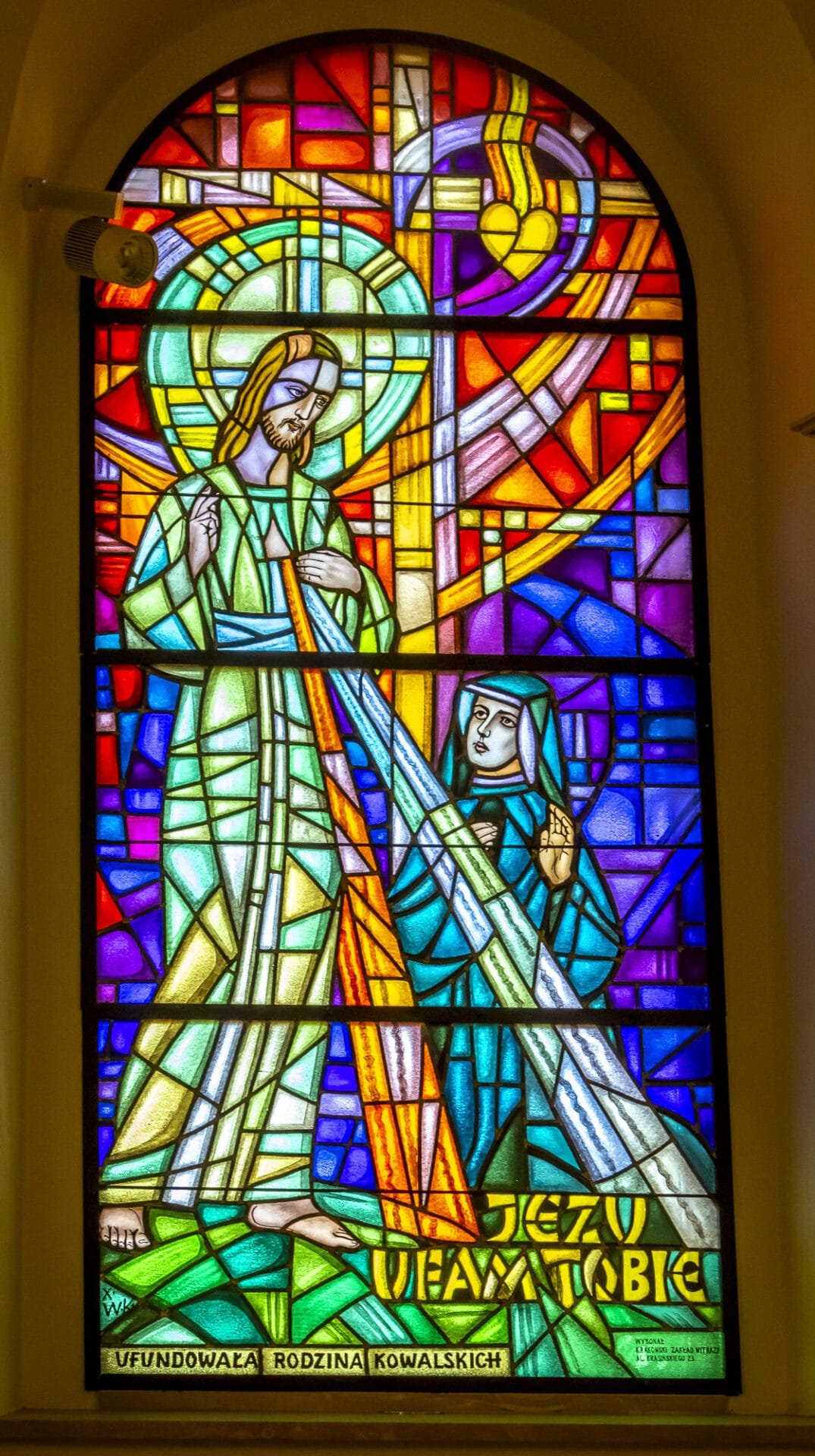
This window shows the Sacred Heart of Jesus. It was funded by the Kowalskich family.

This stained glass image commemorates the martyrdom of St. Maximilian Kolbe.
“OSWIECIM 1941” refers to the Auschwitz concentration camp and the year of his death.
“B-M-KOLBE” is an abbreviation for Blessed Martyr Kolbe. (He was canonized as a saint after this window was created.) “16670” was his prisoner number. The text at the bottom indicates the window was funded by employees of the Polish State Railways.

The Polish text at the bottom translates to “Queen of the Holy Rosary, pray for us”. Below that, translates to “Funded by the women of the entire parish”.

This image shows Saint Casimir. Saint Casimir was a Crown Prince of Poland and Grand Duke of Lithuania and patron saint of both Lithuania and Poland. He is shown receiving a crown by the Virgin Mary. This window was funded by the Kałucki family in Kubiaków

This is the confessional used by Helena Kowolska as a child. Note the date of 1877.

In more recent times, St. Casimir’s Church was enlarged to include a new, modern altar. This was done without destroying the original church by adding a wing to the rear of the original church. The altar features a large gold-painted world map mural on the wall, and central to the altar is an image of the Divine Mercy. The Polish inscription at the bottom of the image reads “Jezu Ufam Tobie,” which translates to “Jesus, I trust in You”. The statue to the left is of St. Faustina.

The parish priest provided a commentary on the church, again translated by Agnes. We celebrated mass here. After mass, the parish priest started climbing on the front pew and we wondered what he was doing. He was trying to get a photo of Fr. Bob.

He clearly has done this before. He was able to align Fr. Bob with the golden globe of the tabernacle. Here is the image he shared with us.

It was also a great place for a group photo. Thank you, Agnes, for taking our group photos.

Moving outside the church we found an outdoor chapel dedicated to St. Faustina.


The sculpture depicts St. Faustina as a young girl shown with an adult figure (sometimes interpreted as her mother or the Blessed Virgin Mary).

From St. Casimir’s Church you can see the cross above the local convent of Congregation of the Sisters of Our Lady of Mercy, the order to which St. Faustina belonged.

This statue of Mary has an inscription below of “:”Mary, Mother of Mercy, Hope, and Forgiveness, Come to the Aid of your People.”

This Marian grotto is dedicated to victims of World War II and the communist era. A statue of the Virgin Mary holding the infant Jesus is the focal point of the shrine, set within a rock grotto. The plaque on the left commemorates Poles who “suffered, died in the Second World War in a murderous year 1944”, listing numerous names. The smaller plaque on the right bears the name “JZY PIPIELUSZA” (Jerzy Popiełuszko) and the logo of “SOLIDARNOŚĆ” (Solidarity), the Polish trade union and pro-democracy movement prominent in the 1980s. Father Jerzy Popiełuszko was a Catholic priest murdered by the Polish communist secret police in 1984. The bottom of the left plaque includes a biblical quote: BOŻE PRZYSZLI POGANIE DO DZIEDZICTWA TWEGO ROZLALI KREW ICH JAK WODĘ A NIE BYŁO KTOBY GRZEBAŁ (“O God, the heathens have come into thy inheritance, they have shed their blood like water, and there was no one to bury them”), from Psalm 79.


More About St. Faustina
At age 16 Helena left home to work as a house keeper in a larger town about 25 miles away, and then to Lodz, to support herself and her family. At age 18 she had a vision of a suffering Jesus who asked her “How long shall I put up with you and how long will you keep putting me off?” She went to the Lodz cathedral when, in another vision, Jesus instructed her to go to Warsaw and enter a convent. She left immediately taking only the dress she was wearing.
Upon arrival in Warsaw, she entered the first church she encountered, St. James Church. (We visited St. James Church on our first day in Warsaw.) The priest, after listening to Helena’s story, instructed her to go the nearby convent, The Sisters of Our Lady of Mercy, where she was eventually accepted in 1928. She received the name Maria Faustina of the Blessed Sacrament. In 1929 she was posted to the convent in Vilnius and then on to Plock.
She continued to have visions of Jesus. In about 1931, Jesus commanded her to keep a diary of their conversations. On February 22, 1931, Jesus appeared to Faustina and revealed the image of Divine Mercy by which He wants to give His mercy to us. She wrote in her dairy, “In the evening, when I was in my cell, I saw the Lord Jesus clothed in a white garment. One hand was raised in the gesture of blessing, the other was touching the garment at the breast. From beneath the garment, slightly drawn aside at the breast, there were emanating two large rays, one red, the other pale. In silence I kept my gaze fixed on the Lord: my soul was struck with awe, but also with great joy. After a while, Jesus said to me, Paint an image according to the pattern you see, with the signature: “Jesus, I trust in You.” [REFERENCE] She commissioned Mr. Eugene Kazimirowski to paint the image, starting January 2, 1934 under her direction.
St. Faustina’s diary is available from Amazon or other book sellers. It is also available as a PDF for free download.
We will see more about St. Faustina in a later post. But, for now, thanks for following along.
Mark


Leave a Reply