Gdańsk is located in northern Poland on the Baltic Sea. Settled by the year 980, it has been destroyed more than once. On September 1, 1939, Adolf Hitler fired on the munitions depot at the city’s harbor, starting WW II. While under German occupation, local Poles were forced to build Nazi U-boats in their shipyards. When the Soviets marched in at the war’s end, nearly 80 percent of the city was destroyed. The historic main streets were in ruins, but locals rebuilt it. Digging through the piles of rubble, they reclaimed original brick and rebuilt the houses just as they looked before the bombing. Looking at Old-Town today you would never imagine it wasn’t built in the 1800s, but was destroyed in 1945. [REFERENCE 1, REFERENCE 2] Old-Town Gdansk is a UNESCO World Heritage Site.
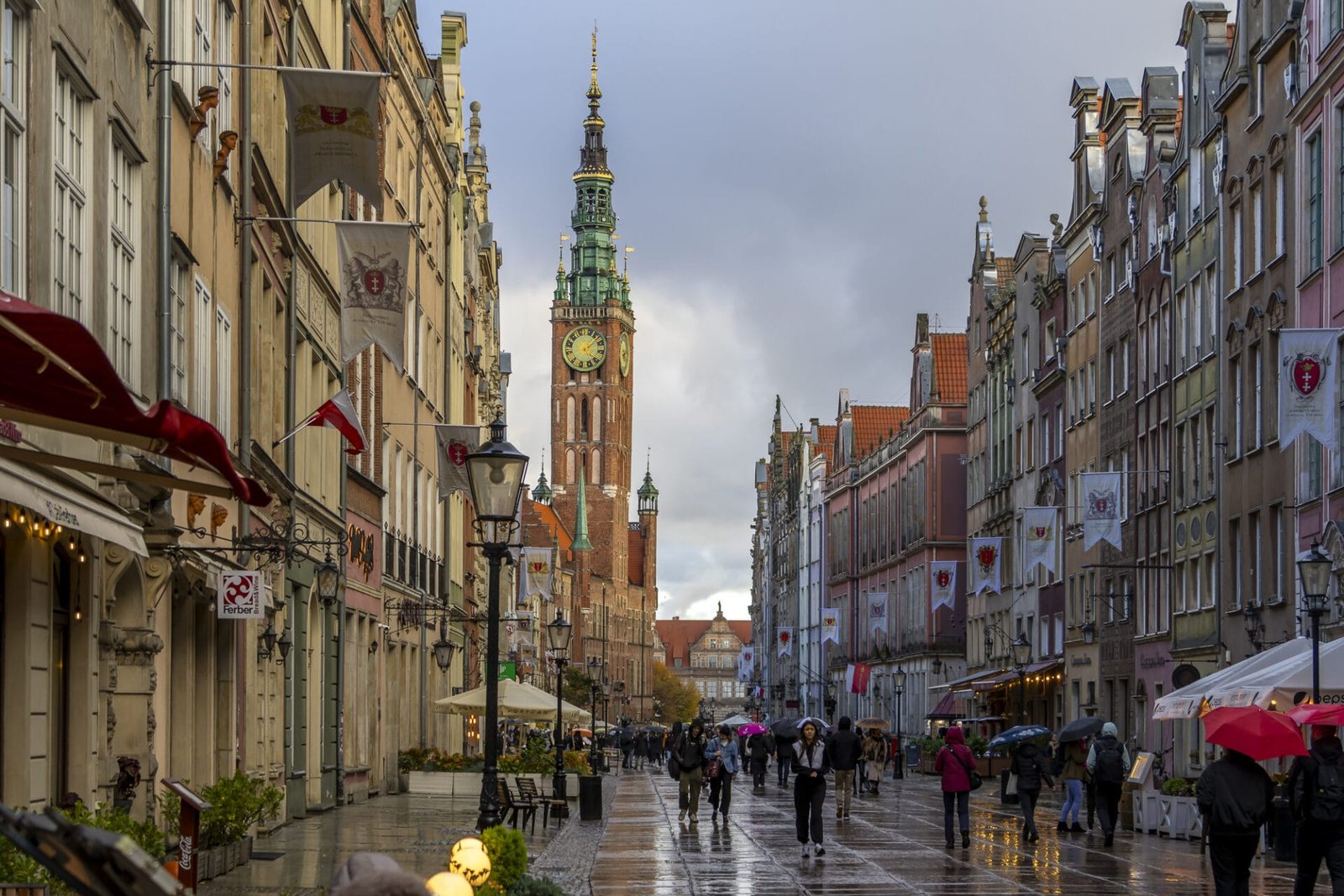
Let’s take a tour of Old-Town. Dluga Street is one of the pedestrian streets in Old-Town. The tower in the background is of the Main Town Hall.


Neptune’s fountain was built in the early 1600s. In 1634 the fountain was surrounded by a fence decorated with gilded Polish Eagles. In the 1930s, Nazis removed the historic Polish Eagles from the fountain’s fence as part of removing traces of the city’s Polish history and heritage. The fountain was damaged during World War II and moved to German-occupied Parchowo. After World War II the fountain was renovated (including the Polish Eagles), moved back to Gdansk, and put back to operation on July 22, 1957. [REFERENCE]


Many of the buildings along Dluga Street were houses owned by Burghers, a class between peasants and the noble. Each was decorated in some unique way to demonstrate their wealth. [REFERENCE] The following photos show some the decorative art work.


This building displays a sgraffito decoration. Sgraffito, a technique produced by scratching through a surface layer of plaster to reveal a different colored layer beneath. [REFERENCE]


This statue outside of St. Mary’s Church, known as a Prussian Hag, was created by an indigenous Old Prussian tribe dating back to the 8th to 13th century . Only 21 of these sculptures are known to exist.

The Great Armory was built in 1605. Originally built as an arsenal, it is now used by the Academy of Fine Arts.

This statue from the Great Armory is of Athena, the ancient Greek goddess of warfare.

In this view of the Great Armory, note the gargoyle down spouts.

We’ve move over to Mariacka Street. Gotyk House is the oldest remaining tenement house in the city, built in 1451. Today the building houses a modern hotel [REFERENCE] and a shop called “Kopernik Toruń Souvenirs & Pamiątki z Gdańska”, which sells traditional products like Toruń gingerbread cookies (Pierniki). [REFERENCE] We’ll get back to Torun gingerbread in a later post.


As we near the Archaeological Museum, we find several bas-relief sculptures. This one is of the Roman goddess, Diana, goddess of the hunt. An unusual addition was made to this sculpture in 1957. If you zoom in on the moon, you can find a small lunar vehicle added to celebrate the Soviet Union’s launch of Sputnik.

This bas-relief sculpture, featuring a mermaid riding a dolphin and pointing to the sun.

This sculpture shows a female figure reclining with a globe and a telescope depicting an allegory of Astronomy (also referred to as the Allegory of Science).

This image is a bas-relief carving depicting a woman holding a skull. The symbolism of the skull is death and the fleeting nature of life, reminding the viewer to live wisely in the present. The snake often symbolizes wisdom, knowledge, and rebirth due to the shedding of its skin. The combination with the skull reinforces the theme of wise reflection on mortality. The book beneath her indicates learning, knowledge, and the study required to attain wisdom. The carving combines these elements to represent the act of gaining wisdom through the contemplation of life and death. [REFERENCE]


The figure shown here is with a compass, a common symbol for wisdom and the ability to measure and plan for the future. The celestial sphere in the background is complete with stars and zodiac signs (Aries, Taurus, and Gemini are visible).


St. Mary’s Gate, built in the late 15th century, stands between Mariacka Street and the Motława River.


Just as we passed through the gate, the bridge we needed to cross the Matlawa River to get back to our hotel rotated from pedestrian traffic mode to boat traffic mode. This rotating bridge allows pedestrians to cross the river for about half an hour, then allows larger boats to pass for half an hour. Since we had half an hour to wait, we continued our tour.

This huge, wooden crane was used to load and unload ships on the Matlawa River. It was operated by workers walking around in giant hamster wheels. Using just their foot power to engage the gears and pulleys, they could lift up to four tons. The original crane was built in 1367. After a fire, it was rebuilt in 1444. It was heavily damaged again in 1945 and, once again, rebuilt in the 1950s. Like much of Gdansk old-town, it was rebuilt to match the original. [REFERENCE 1, REFERENCE 2]


By now, it was time to go back to our hotel, rest a bit, and head to dinner. Tomorrow we were to travel to Torun and visit the childhood home of St. Faustina. It will be another long, exciting day.
Mark


Leave a Reply