In my previous post we toured the exterior of this wonderful castle. In this post, we move inside.
To help navigate the interior, I found a website that has an interactive map that might be helpful. It doesn’t contain locations for all the rooms we were in, but offers some perspective. I have found it difficult to accurately place where all the photos were taken, so some IDs may be off. Some information came from this Reference. I’ve also used AI (Gemini) to help ID some of the murals and other art work.
We start our tour in the Great Refectory. This room was initially used for ceremonial feasts and banquets for up to 400 knights.

The Great Refectory contains some wonderful murals. The central figure on the left of this mural, wearing a crown and blue tunic likely represents Emperor Louis IV, Holy Roman Emperor. The figure on his knees in front of the Emperor is likely Dietrich von Altenburg (Theoderic of Altenburg), who was the Grand Master of the Teutonic Order from 1335 to 1341. The mural illustrates the Emperor granting the privilege of the land to the Grand Master and the Teutonic Order. The Latin inscription at the bottom indicates a donation of land which translates roughly to “Emperor Louis donated the land of the inhabitants in perpetuity to Theoderic of Altenburg”.

The mural illustrates a chaotic battle scene with knights on horseback carrying shields displaying various coats of arms.

This mural depicts a historical scene involving knights on horseback

This artwork illustrates a historical moment involving the Teutonic Knights and figures from the surrounding regions. The Latin inscriptions at the bottom references translate to “Duke Otto of Brunswick” and “Brothers in the Land of Prussia”, indicating a specific historical narrative related to the Teutonic Order’s presence in the area.

This mural depicts figures on a medieval ship in a stormy sea, possibly illustrating a historical event or a symbolic journey. The text visible at the bottom mentions “Terressam” (land) and “Borussias marchionis Vismensis” (Prussian land of the Vistula marches).

This painting illustrates a battle scene during the Prussian Crusade, specifically referencing historical figures and locations in the Latin text at the bottom. The text mentions “Burchardus de Mondeburg” (Burgravius de Mejheburgk) and “Hermannus Balke,” who was a Master of the Teutonic Order.

This painting depicts the Coronation of the Virgin. The scene shows Jesus Christ, identified by his halo, placing a crown on the bowed head of the Virgin Mary, crowning her as the Queen of Heaven.


As we make our way out of the Great Refectory we are in this ornate hallway near the Grand Master’s quarters.


This ornamental cartouche has a five-field shield on it. The coat of arms of Poland (Eagle) in the first and fourth field, the coat of arms of Lithuania (Vytis) in the second and third field. The coat of arms of the Vasa dynasty (sheaf) in the central field. Over the cartouche, there is a crown topped with a cross. In the top left corner of the plate, there are illegible remains of a minuscule inscription in pencil: “Marienburg. Mittelschloß. (…) Kamin. W. Remter. Hochmeisterpalast”.

We step outside to move from part of the castle to another.


This is the entrance to the High Castle. Above the archway, there is a bas-relief sculpture depicting a Teutonic Grand Knight on a horse.


This well in the inner courtyard is adorned with a sculpture of a pelican. I’ll have a better view shortly.


The next few images are from a hallway leading to the Chapter House.


The Chapter House was likely a meeting room for the knights and others in the castle. This room is also richly decorated with murals. This fresco depicts the Virgin Mary enthroned with the Christ Child on her lap, flanked by two angels, under an ornate Gothic archway. Two shields displaying coats of arms are visible at the base of the scene, representing associated individuals or institutions, a common feature in medieval art to denote patronage or affiliation.

The main image below depicts Christ on the cross, surrounded by circular motifs featuring stylized plant or vine designs. The fresco includes text written in an old form of German. Unfortunately, Google Translate could not resolve the text.

The two frescos below depict religious figures under a painted representation of gothic architecture. The internet identifies the central figures of each as possibly St. Stephen, the church’s namesake.


This mural depicts three standing figures, likely saints or grand masters of the Teutonic Order, each holding a shield bearing a cross emblem, a common symbol associated with the Teutonic Knights.


The sculpture of the pelican in her “piety” sits atop a well in the High Castle’s inner courtyard. It is a medieval Christian motif where a mother pelican is shown wounding her own breast to feed her young with her blood. This act was commonly used in medieval art to symbolize Christ’s sacrifice for humanity and the Eucharist.


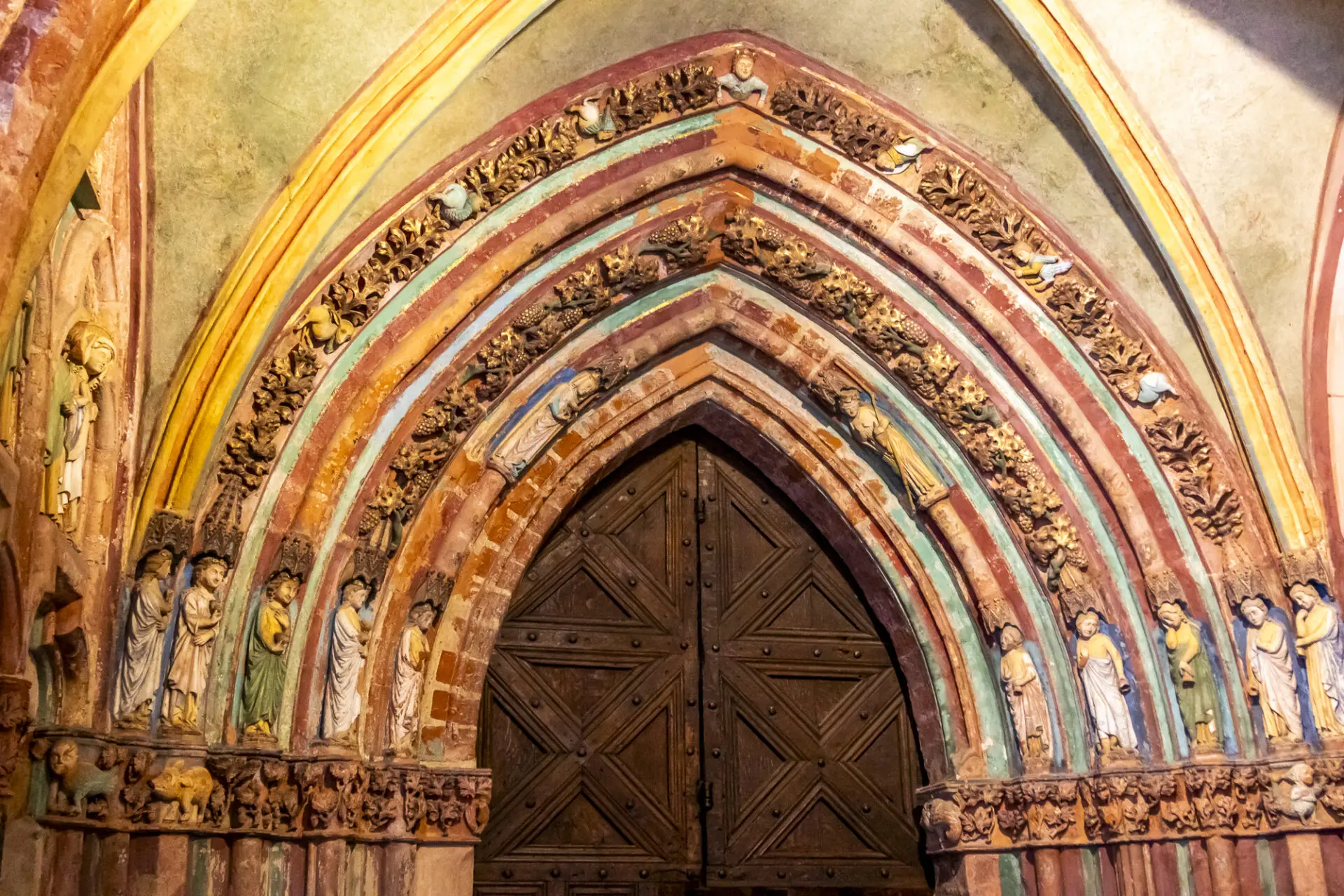
This entrance to the Church of the Blessed Virgin Mary within Malbork Castle is highly decorated.

This detail from the entrance shows the five wise virgins that brought oil for their lamps.

However, these five virgins brought no oil and were not allowed entrance to the wedding feast.

These details depict religious scenes, including a Nativity scene in the main lower right section of the first photo, showing figures gathered around the infant Jesus in a manger. The scene above it likely depicts related biblical narratives from the life of Christ or the Virgin Mary.


Entering the church, we find this large, green crucifix, a notable artifact located within St. Mary’s Church. Note the missing pieces.

This altarpiece is the Triptych with the Coronation of the Blessed Virgin Mary, also known as the Tenkitten Altarpiece, a late Gothic carved altarpiece from around 1504.


This artwork is known as the Altar of Saint Anne. The piece is a German Gothic altarpiece dating to around 1516 and is made of painted and gilded wood. The altarpiece features two tiers of carved figures within an ornate, architectural wooden structure. It depicts the Holy Kinship, which refers to the extended family of Jesus, centered around his grandmother Saint Anne. Saint Anne is typically depicted holding the Virgin Mary and the Christ Child (shown in the top right). The figures often hold objects that help identify them, such as books, swords, or palms, which allude to their lives or martyrdoms.

This wooden sculpture of the Madonna and Child Enthroned dates back to the 14th or early 15th century.

This carved wood panel is a Gothic altarpiece panel depicting the Crucifixion. The central scene depicts the Crucifixion of Christ on the main cross, flanked by the two thieves on smaller crosses. A crowded assembly of figures is carved below, including the mourning Virgin Mary and St. John the Evangelist, soldiers, and onlookers.

The sculpture shows Jesus in a moment of intense emotional suffering and prayer before his crucifixion.


At this point, we left the castle and headed to the Church of St. John the Baptist. That, however, will be the subject of my next post.
Thanks for making it all the way to the end of this long post.
Mark


Leave a Reply