The Divine Mercy Sanctuary resembles a ship, symbolizing an “Ark of the Covenant”. It serves as the final resting place of St. Faustina Kowalska, the Polish nun whose visions led to the Divine Mercy devotion. We visited the home of St. Faustina in an earlier post.
The following references were used for this post [REFERENCE 1, REFERENCE 2]. All translations were done through Google Translate. Some additional information has been obtained using AI (Gemini).
This sanctuary is a major global pilgrimage site, receiving over two million visitors annually. It was consecrated by Pope John Paul II in 2002, who also entrusted the whole world to Divine Mercy at this location.

We walked to this second sanctuary from the Sanctuary of John Paul II past the Convent Cemetery of the Sisters of Our Lady of Mercy.


The entrance to the main sanctuary shown below, is known as the Gate of Mercy. Because it was evening the lighting was quite nice. The inscriptions on the gate, “Brama Miłosierdzia” (Polish) and “Porta Misericordiae” (Latin), both translate to “Gate of Mercy”.

Adjacent to the entrance were these lighted panels. The one on the left of the entrance depicts The Seven Spiritual Works of Mercy.
Admonish Sinners: To gently correct or guide someone who is engaging in sinful behavior.
Instruct the Ignorant: To share knowledge of the faith and teach those who lack it.
Counsel the Doubtful: To offer guidance and advice to those uncertain about their faith or future.
Comfort the Afflicted: To offer support and consolation to those who are suffering or grieving.
Bear Wrongs Patiently: To endure mistreatment or injustice without seeking retaliation.
Forgive Offenses: To let go of grudges and willingly forgive those who have caused harm.
Pray for the Living and the Dead: To intercede through prayer for the spiritual well-being of all, including those who have passed away.

And, to the right of the entrance, were the Seven Works of Mercy.
Feed the Hungry: Providing food to those who lack it.
Give Drink to the Thirsty: Ensuring access to clean water.
Clothe the Naked: Donating clothing for warmth and dignity.
Shelter the Homeless: Offering refuge to those without a home or fleeing danger.
Visit the Imprisoned: Offering support and spiritual guidance to those incarcerated.
Visit the Sick: Caring for those who are ill, home-bound, or in nursing homes.
Bury the Dead: Honoring the deceased through respectful burial and supporting grieving families.

The main altar of the sanctuary features a large Divine Mercy Painting. The altar is framed by a striking metal sculpture resembling wind-swept trees, symbolizing the power and movement of divine mercy. To the left of the central image is a portrait of Pope John Paul II, and to the right is a portrait of St. Faustina Kowalska, both of whom were instrumental in spreading the Divine Mercy devotion.

This holy water font contains several scriptural elements. The central column supporting the font is decorated with an apple and bread, which serve as symbols for sin and grace, respectively. The inner surface of the basin is a turquoise color, intended to evoke the color of the sea. Visible through the water in the bowl is the shape of a fish, an ancient symbol for Christ and the Christian people. The font features a Polish inscription from the First Letter to the Corinthians: “As in Adam all die, so in Christ all will be made alive” (1 Cor 15:22).


The carillon consists of 9 bells situated in front of the sanctuary’s basilica. Each bell has a name inscribed on it. The first three are Jesus, Sister Faustina, and John Paul II. The remaining six are named after other saints from Kraków: St. Stanislaus, St. Jacek, St. Jadwiga, St. John Cantius, St. Rafał, and St. Albert. The wall below the bells features the Latin phrase “Misericordias Domini in aeternum cantabimus,” which translates to “I will sing forever of the Lord’s mercy”. Below the bells are plaques honoring figures and entities significant to the sanctuary, including Pope John Paul II, Cardinal Stanisław Dziwisz, Cardinal Franciszek Macharski, and the Archdiocese of Kraków.

This “old” church, the Chapel of the Miraculous Image of the Merciful Jesus, formerly known as the Chapel of St. Joseph, is at the heart of the complex. It contains the miraculous image of the Merciful Jesus (the Divine Mercy painting) and the tomb of Saint Faustina Kowalska.


This circular stained glass window depicts Saint Cecilia, the patron saint of music and musicians, shown playing a pipe organ.

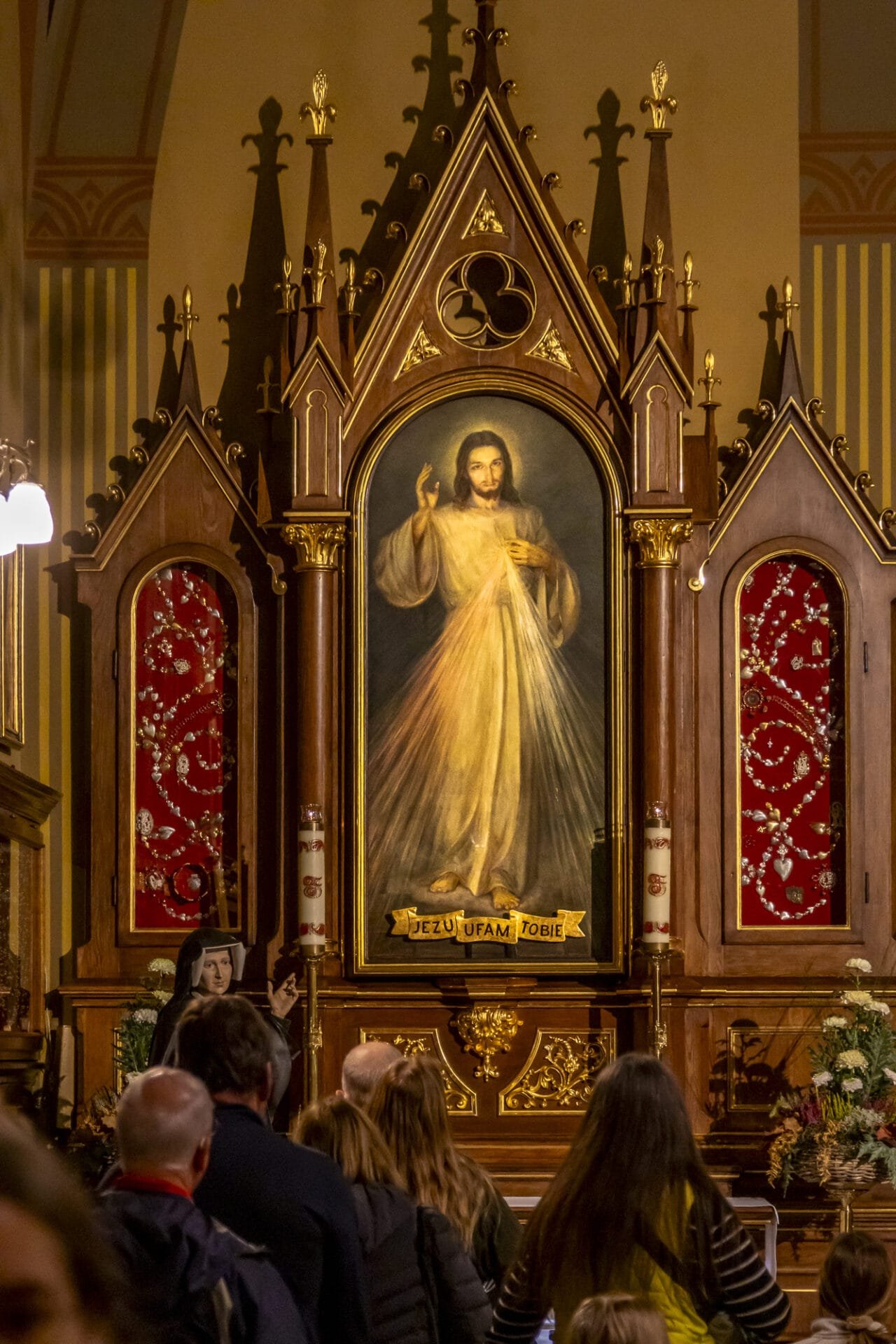
Here is the interior of the Chapel of the Miraculous Image of the Merciful Jesus, which houses the tomb of Saint Faustina Kowalska. It is the historical heart of the Divine Mercy Sanctuary. Features of this chapel include the Divine Mercy Painting located on the side altar to the left. This is the world-renowned “Jesus, I trust in You” image painted by Adolf Hyła. Under this painting lie the mortal remains of St. Faustina in a white marble coffin on the altar. A special marble kneeler in front of the altar contains a first-class relic of St. Faustina. The Polish text on the arch above the left side altars reads “Miłością wieczną umiłowałem Cię” (I have loved you with an everlasting love) and above the altar on the right “Dlatego przyciągnąłem Cię, litując się” (Therefore, I have drawn you, taking pity). The altar on the right shows a painting of St. Joseph, the original patron of the chapel and the surrounding convent.


The Divine Mercy Painting is located at the tomb of St. Faustina Kowalska. The Painting shows Jesus with two rays emanating from His heart—one red and one pale—representing blood and water. The inscription at the bottom, the Polish words “JEZU UFAM TOBIE” are visible, translate to “Jesus, I Trust in You”. Note how the statue of St. Faustina is pointing to Jesus.


There is sometimes so much beauty surrounding us we forget to look up. Here is the ceiling of the chapel.

As we leave the sanctuary, we again look up and see this statue of John Paul II as the “Pilgrim of Peace”. He is shown holding a dove, symbolizing the message of peace and Mercy he sought to bring to the world. The statue features the pope with one hand raised holding the papal staff. The presence of the yellow and white flag next to the statue further confirms its association with the Vatican, as these are the official colors of the Holy See.

Here is the same statue from another angle.

Visits to these two sanctuaries is a fitting way to close out the official part of our pilgrimage. What remains are some good food, singing, and dancing, but that will have to wait until the next post.
Until then,
Mark


Leave a Reply