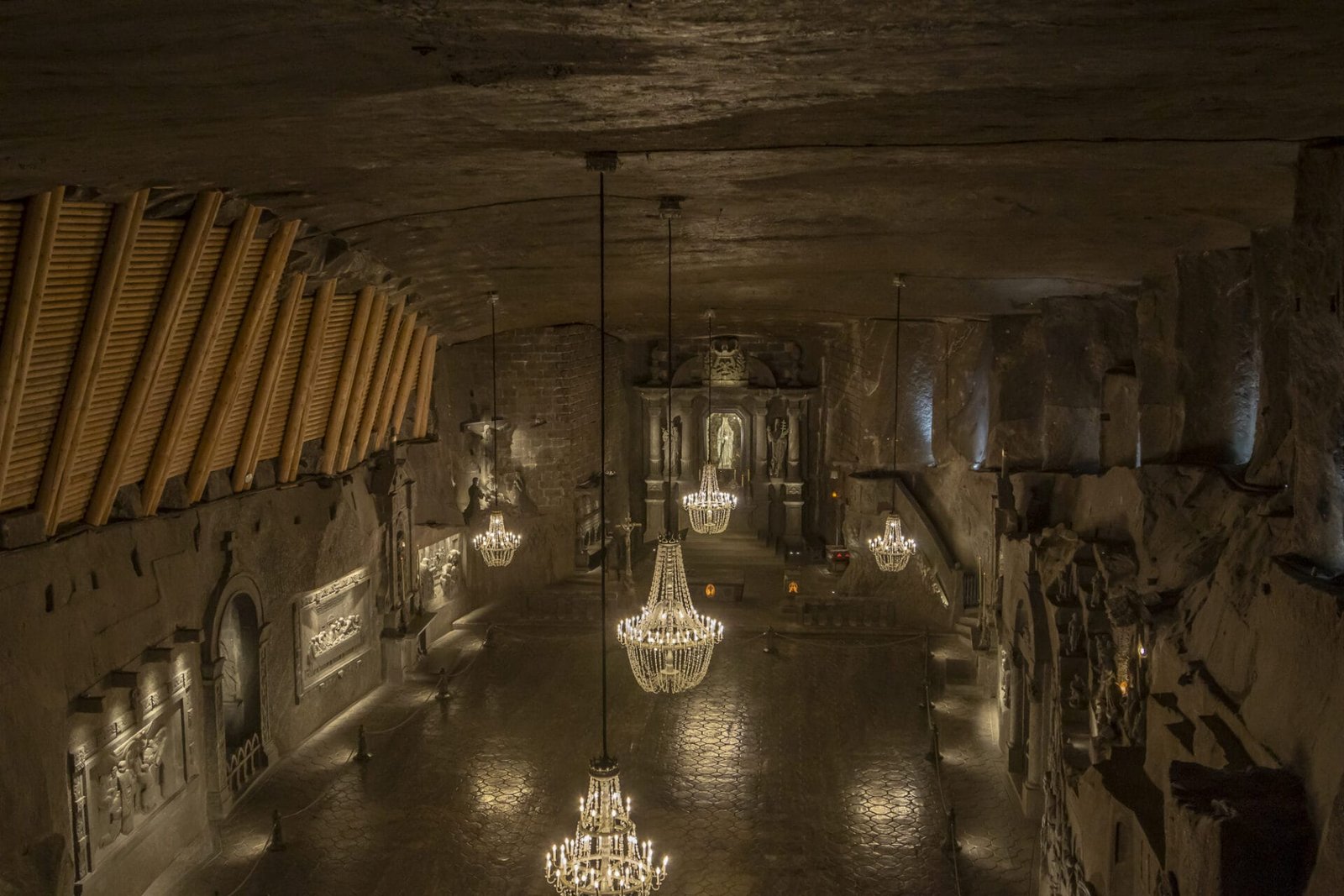
Its Day 7, and our first stop is the Wieliczka Salt Mine in the town of Wieliczka, near Kraków in southern Poland. I previous posts I’ve shown many sculptures, but in this post, all the sculptures are carved from salt.

I have relied on the following references for my descriptions of the mine. [REFERENCE 1, REFERENCE 2, REFERENCE 3]. All translations have been performed using Google Translate. A few identifications were done using AI (Gemini).
Note: Reference 2 above has a wonderful 360 degree tour through much of the visitor’s route we followed. Scroll down a short way and find the box labeled “Virtual Walk Panorama 360 degrees”.
History
From Neolithic times (starting about 10,000 BC), table salt was produced in this area from brine coming up from the ground in springs and later from wells dug to capture the brine. This image from the mine depicts these salt workers.


The Wieliczka salt mine was first excavated from the 13th century and produced table salt continuously until 1996. Due to falling salt prices and mine flooding, commercial salt mining was discontinued in 1996. The Wieliczka Salt Mine is now an official Polish Historic Monument and a UNESCO World Heritage Site. It features mining shafts and passageways, displays of historic salt-mining technology, an underground lake, four chapels and numerous statues carved by miners out of the rock salt, and more recent sculptures by contemporary artists.
The mine reaches a depth of 1,073 feet, and extends via horizontal passages and chambers for over 178 miles. The rock salt is naturally of varying shades of grey, resembling unpolished granite rather than the white crystalline substance that might be expected. The 2.2-mile visitors’ route which we took consists of less than 2 percent of the mine passages’ total length.
Let’s Begin our Tour
Outside the mine is this emblem that translates to Wieliczka Salt Mine. The logo features two miners in traditional attire holding pick-axes over their heads. Other tools in the center of the emblem represent hammers, chisels, and wedges used for mining.

The miner’s elevator has two levels. Note that there are two compartments, one on the right behind the orange gate and another above it. One car is loaded, lowered enough that the second car can be loaded. Both cars ascend or descend at the same time.

Our first stop is 210 feet below the surface.

Chapel of St. Anthony
The Chapel of St. Anthony is the oldest preserved underground chapel in the mine. It was build between 1690 and 1710 by miners, serving as a holy place for workers, featuring salt sculptures of saints, an altar, and a pulpit. Restoration work is ongoing due to natural salt dissolution by water percolating through the mine. The pulpit is shown below. Note the sign with the date 1698, the date of the first mass here. Also, not the form of a dove at the ceiling.

This statue of St. Paul is located just to the right of the pulpit.

This statue of St. Peter is located to the left of the pulpit.

This side chapel contains more statues of unknown (at least to me) robed figures and shows serious signs of water damage over the years.

This chandelier is hung in the St. Anthony Chapel. Each crystal is hand carved from salt.

Some surface water still percolates through the salt mine causing these salt “roses” and stalactites. The continuing infiltration of water has taken its toll on this chapel as everything is carved from salt.


Chapel of the Holy Cross
This is another small chapel a bit further down the corridor, the Chapel of the Holy Cross, also known as the St. John Chapel. It was built in 1876 as a thanksgiving offering after a period of catastrophic flooding. Again, humidity has taken its toll on these statues.


Sculptures Along the Passageways
This next image depicts the legend of St. Kinga. Below is the legend of St. Kinga. [REFERENCE]
“Long, long ago, Prince Boleslaw Wstydliwy was the ruler of Poland. He decided to ask the princess of Hungary, Kinga to marry him. Consequently, he sent a message to the court of the Hungarian King Bela IV. Also, he ordered to give an engagement ring to princess Kinga. She agreed to become a Polish princess.
“Kinga’s father wanted to give her gold and jewels as dowry, but the princess said that this would not be good, since the Polish king was wealthy and his county lived in prosperity. Kinga’s father asked her, “So, what dowry do you want, my daughter?“ After some thought, the princess asked her father to give them salt, which would gain the appreciation of Boleslaw and his subjects as salt at that time was extremely appreciated.
“The father, wanting to meet the request of his daughter, took her to the mine in Marumuresz, Hungary, and said, “You have what you asked, here are rich salt deposits“. However, the king was pensive, because he did not know how to move all the salt to the Polish mine. She lifted her eyes, asking God for advice and after a while she knew what to do. She removed her engagement ring from Boleslaw and threw it into the mine shaft. Courtiers who saw it were a little surprised, but they said nothing.
“Soon, Kinga went to the court of King Boleslaw near Warsaw, where he waited for her arrival, and they were wed. Several days after the wedding, seeking to find her dowry, she asked her husband to show her the kingdom. So the whole procession came, and the king showed her the beautiful land of his principality. At one moment, Kinga told them to the stop and directed her servants to dig in the ground. When the attendants came upon a rock and said that further digging was impossible. Kinga ordered them to split off a piece of rock. One of the peasants gave Kinga a white piece of rock, which was a lump of salt. She ordered them to split it and her engagement ring fell out of the lump. Then they all understood what a dowry her father gave her and that the ring, which she threw into the mine in Marumuresz, brought precious salt to Poland. Since then, the mine in Wieliczka is famous for its rich salt deposits. Princess Kinga wisely ruled the Polish people for a long time.”

Methane Gas
Methane gas was a real danger in the mines. These next images depict miners checking for this flammable gas which was lighter than air. One job in the mine was to take flaming torches on long poles to probe the higher ceilings in the mine. If flammable gasses were found they would burn in a flash. This prevented the build-up of these gasses. Again, these are all carved out of salt.


Depictions of Miners at Work
The next few images show miners at work, demonstrating the difficult work and methods used over the centuries using simple tools.


More Sculptures Along the Passageways
More sculptures line the passages of the mine. Here is King Casimir III who reigned from 1333 to 1370. He was instrumental in regulating and developing the salt mining industry in the region. The income generated from the salt mines accounted for approximately one-third of the state treasury’s revenue during his reign.


These stairs, carved out of the salt, were used by the miners long before an elevator was installed.

Gnomes or dwarf statues were carved from salt in the mine. The glowing object in the first image appears to be a light source added for visual effect, highlighting the translucent quality of the rock salt.


As I mentioned above, moisture and water is an enemy of the salt sculptures. This trough directs brine, fully saturated salt water, from another portion of the mine. It is pumped to the surface where it is evaporated for salt production. The green coloration in the brine is due to the addition of clay stones in the rock salt deposits prevalent in the mine.

We are now 290 feet below the surface.

This statue of Mary and Jesus have been painted and is known as “Mother of God Victorious”.


St. Kinga’s Chapel
St. Kinga’s Chapel is huge. Devout miners carved an entire church and its furnishings from the rock salt, 331 feet below ground. The chapel is still a functioning church, used for Sunday Masses, weddings, and concerts. The walls, floor, ceiling, sculptures, and even the chandeliers are carved entirely from natural, gray rock salt over a period of nearly 70 years, from 1896 to the 1960s.

The walls are lined with sculptures and bas-reliefs.


This statue of God is just above the statue of the Madonna with Child below.

Here, in the place which used to hold a sacristy, is the chapel of the Madonna with Child. It is decorated with two sculptures presented at the Paris Exhibition in 1900. The statues of God and the Madonna with Child are copies of works from the Chapel of St Anthony.


This is the main altar. On the sides of the altar are the statues of St Joseph of Nazareth and St Clement, protector of miners. The relics of St. Kinga, the patron saint of salt miners, are kept in a reliquary placed in the altar. The coat of arms of the town of Wieliczka is above the alter.

Here is a closer view of St. Kinga holding a rock of salt.


Underground Salt Lake
This lake is completely saturated salt water. Again the green color is due to a clay stone also dissolved in the water.

Gift Shop / Snack Bar
No tour like this is complete without a stop at the gift shop. But of course, this one is located hundreds of feet below the surface.

This mine was one of the twelve original UNESCO World Heritage Sites.

The Treasure Keeper is the legendary spirit of the mine. In Polish mythology they live in mines and underground workings and are the guardians of gems, crystals, and precious metals. In the Wieliczka mine, salt, of course, is the treasure in question. Skarbnik is a good spirit, but he always comes bearing a warning. If he should appear, that means there is dangerous gas, or a cave-in up ahead. Skarbnik will protect miners from danger, and lead them back when they are lost. [REFERENCE]


Chapel of St. John Paul II
We were able to attend mass in this small chapel dedicated to St. John Paul II.


The altar is made of solid salt. The crucifix is created by cutting a large stone of salt into four pieces, separating them slightly, and creating the luminous cross in its center.


End of the Tour
This is our last stop, heading back up the elevator from 443 feet below the surface.

They say the salt air in the mine is good for you. Studies have found that halotherapy, breathing salt air, can have benefits for respiratory conditions, skin problems, and allergies. [REFERENCE] Perhaps it is so. We all made it out of the mine none the worse for it, and better in many ways having seen these below-ground wonders.
Mark


.jpg#:~:text=English:%20The%20Treasure%20Keeper%20is,back%20when%20they%20are%20lost.)
Leave a Reply