Old-town, Krakow, is another UNESCO World Heritage site. Krakow the center of Poland’s political life from 1038 until King Sigismund III Vasa relocated his court to Warsaw in 1596. The Main Market Square, one of the biggest squares in Europe, which came into existence in 1257. There are many attractions such as the Town Hall Tower, the Cloth Hall, and old tenements with fine shops. While near the monument, one can listen to the heynal, which is played each hour from the highest tower of St. Mary’s Church. More on this later.
One treat found all over the square is the obwarzanki krakowskie. These twisted ring-shaped breads are a unique symbol of Kraków. On the Square there is a obwarzanki seller every few steps. (I thought they were pretzels.) Traditional obwarzanki are sprinkled with poppy-seeds. Today, sellers offer a whole variety of them; apart from poppy-seed, there are also sesame seed, rock salt and even pizza sprinkles. [REFERENCE]

St. Mary’s Basilica
This post will focus on St. Mary’s Basilica. The basilica was built in the 14th century on a foundation from at least a century earlier. One of the most unusual features of the church are its asymmetrical towers. According to legend, the uneven towers were built by two brothers. As the older brother’s tower rose higher and faster, jealousy consumed the younger. In a fit of envy, he murdered his sibling, finishing his own tower to make it the tallest. But guilt overtook him – and when the tower was complete, he stabbed himself with the same knife and jumped from the top. [REFERENCE]


Although the next couple images are attached to St. Barbara’s Church, they are next to the entrance of St. Mary’s Basilica. The relief depicts Anna Guldenstern, the first wife of George Pipan, a doctor and pharmacist from Krakow. The inscription below the figure includes the Latin phrase “OPTIMAE FEMINAE ANNAE” which translates to “To the Best Woman Anna”.

This is the epitaph relief of George Pipan.

This Crucifix is surrounded by the figures of the Virgin Mary, Saint John the Evangelist, and Mary Magdalene mourning over the body of Jesus.

This is a sculpture of an unknown figure outside St. Mary’s Basilica.


Interior of St. Mary’s Basilica
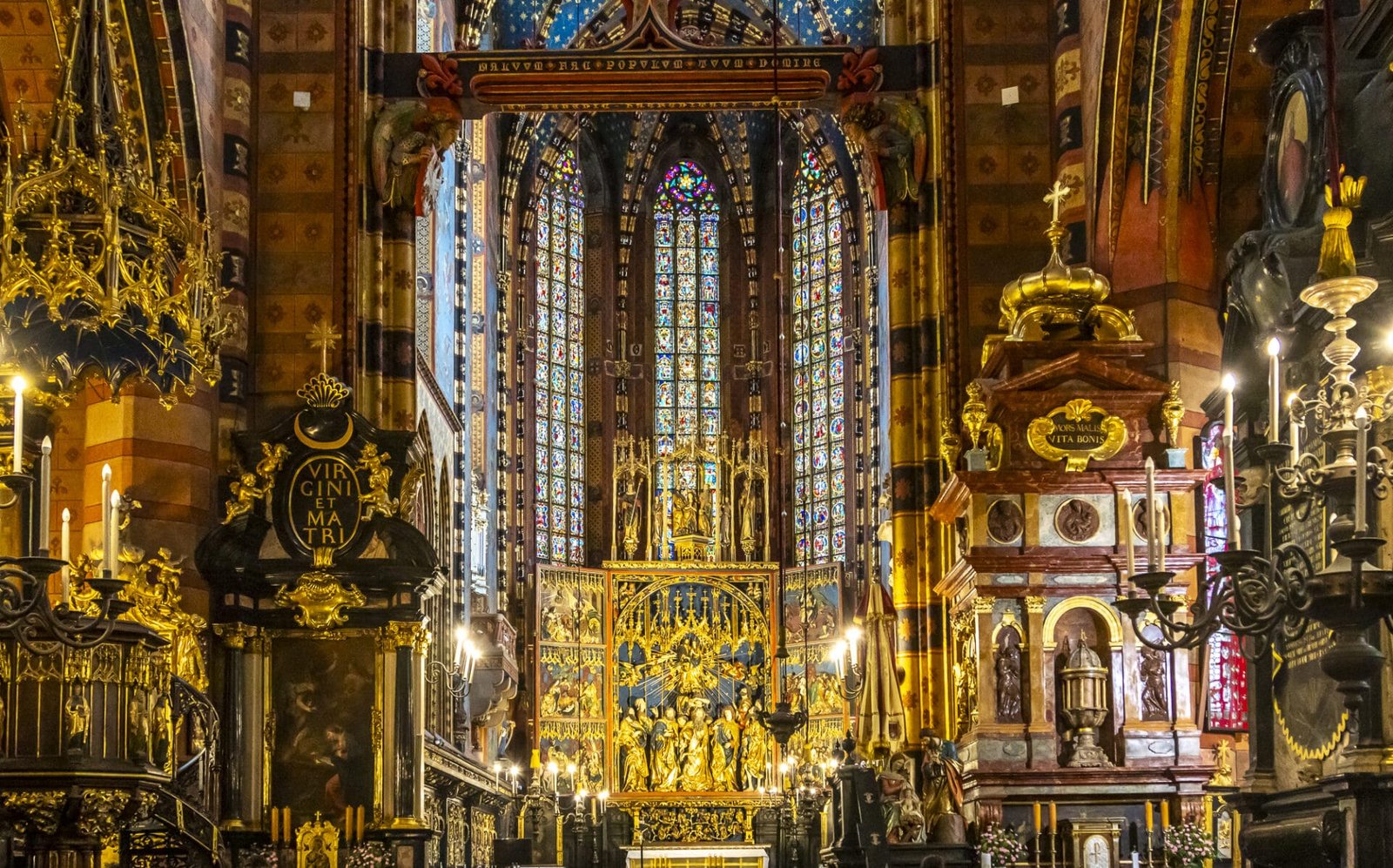
Once inside the basilica, we are met with a wonderful example of Polish Gothic architecture [REFERENCE]. Here is the main altar in the basilica.

This crucifix hangs high above the famous altar by Veit Stoss.

Here we see the crucifix and the altar together.

The masterpiece of the basilica is Veit Stoss Altarpiece, considered a national treasure of Poland [REFERENCE]. This altar is located behind the high altar of St. Mary’s Basilica. The altarpiece was carved between 1477 and 1489 by the German-born sculptor Veit Stoss. The Altarpiece is about 42 feet high and 36 feet wide when the panels of the triptych are completely opened. The realistically sculptured figures are more than 12 feet high. When closed, the panels show 12 scenes of the life of Jesus and Mary. (It is fully open here.) The scene at the bottom of the main altarpiece shows the Dormition of Mary in the presence of the Twelve Apostles. The upper center part illustrates the Assumption of Mary. At the very top, outside the main frame, the coronation of Mary is shown, flanked by figures of Saint Stanislaus and Saint Adalbert of Prague. The side panels show the six scenes of the Joys of Mary (which I unfortunately did not capture).

At the top of the altar we have a depiction of the Coronation of Mary.

This lower portion shows the Dormition of Mary.


Here is the stand of organ pipes in the rear of the basilica.

This ornate archway has text in Latin (Perictum Anno Domini Восс) that translates to Completed in the year of our Lord 800. This pre-dates the construction of this basilica, so may refer to another part of the church’s history. The text near the top, CHRISTUM ORA translates to Pray to Christ.

This alter depicts the resurrection of Peter Miles. The legend is as follows.
During the reign of Duke Boleslaw II of Poland, St. Stanislaus, Bishop of Krakow, was falsely accused of stealing land from a man named Peter Miles who died 3 years earlier. Boleslaw, seeking revenge for the Bishop’s moral admonishments, intimidated witnesses until Stanislaus was condemned to forfeit the property.
Trusting in God, the Saint promised the court that he would produce the deceased Peter Miles to testify. After three days of prayer and fasting, Stanislaus went to Peter’s grave. He commanded the dead man to arise in the name of Christ; the bones instantly reunited and were covered with flesh.
The resurrected Peter walked to the tribunal and testified that he had been fully paid, rebuking the witnesses for their dishonesty. Afterward, Stanislaus offered to pray for Peter to live several more years. Peter declined, stating he preferred to return to the pains of Purgatory rather than risk eternal damnation in the terrestrial world. After asking the Bishop to pray for his soul’s deliverance, Peter returned to his grave and crumbled back into dust. [REFERENCE]


Back Outside
This sundial on the south wall of St. Mary’s Basilica is a relatively new addition. The date, MCMLIV, represents 1954.

Trumpeter
St. Mary’s Trumpet Call, or Hejnal, is a traditional, five-note Polish bugle call closely bound to the history and traditions of Kraków. It is played every hour on the hour, 24/7, four times in succession in each of the four cardinal directions, by a trumpeter on the highest tower of the city’s Saint Mary’s Basilica. [REFERENCE]
Watch this video for an inside view of the tower as the trumpeter plays. [REFERENCE]
This call has been played at the tower of the church of St. Mary since medieval times. Back then, it was an alert call to warn its residents of any dangers. It also marked the opening and closure of the city gates. Another legend tells a related story, in the 13th century, Tatars invaded Poland, and a guard who spotted the danger began to play a trumped call to warn the city, While he was playing, an arrow shot by a Tatar bowman pierced his throat. To commemorate this incident, the trumpet call of the Church of St. Mary always ends abruptly. [REFERENCE]


At the end, the trumpeter waves to the people below.

In the next post, I will look at more of Krakow.
Mark


Leave a Reply