The name Auschwitz calls to mind death and a darkness of the human soul. These concentration camps were set up to house Polish Jews and other “objectionable persons” when local prisons were filled to overflowing. The Auschwitz camps were established by the Germans in 1940 in the suburbs of Oswiecim, a Polish city that was annexed to the Third Reich by the Nazis. Its name was changed to Auschwitz.
Most of the information about Auschwitz presented here has been collected from the following sites [REFERENCE 1, REFERENCE 2, REFERENCE 3, REFERENCE 4, REFERENCE 5] with some info coming from AI (Gemini). All translations were performed using Google Translate. REFERENCE 5 contains many descriptions and stories from survivors.
Auschwitz was a collection of multiple camps. The first and oldest was the so-called “main camp,” later also known as “Auschwitz I” (the number of prisoners fluctuated around 15,000, sometimes rising above 20,000), which was established on the grounds and in the buildings of prewar Polish barracks. The second part was the Birkenau camp (which held over 90,000 prisoners in 1944), also known as “Auschwitz II”. This was the largest part of the Auschwitz complex. The Nazis began building it in 1941 on a site about 2 miles from Oswiecim. The Polish civilian population was evicted and their houses confiscated and demolished. The majority of the mass exterminations occurred in Birkenau. There were also more than 40 other sub-camps, exploiting the prisoners as slave laborers, known as Auschwitz III.
The name Oswiecim is being used again as shown in this photo from the train station.

Initially, Auschwitz was to be just one more concentration camp of the type that the Nazis had been setting up since the early 1930s. It functioned as such throughout its history, even when, beginning in 1942, it also became the largest extermination center where the “Endlösung der Judenfrage” (the final solution to the Jewish question – the Nazi plan to murder European Jews) was carried out.
Today was a long, hard day. This will be a difficult post to write, and perhaps for you to read as well. There were many photos I did NOT take. I couldn’t bring myself to take them out of respect for the history of Auschwitz. In spite of the horror of Auschwitz, the site has been allowed to remain as a museum and reminder to the world of what horror really looks like. The museum was created in 1946 by former Auschwitz prisoners. When our guide was asked how he can work in a place like this, he responded, “This is a story that needs to be told.” And so, he works, day-by-day, to tell the story, not to glorify it, but to remind us. I hope my photos have captured some of this story.
We start our tour at Auschwitz I. Before entering the main camp, we were lead through a path where the names of some of the victims of Auschwitz were broadcast over speakers, reminding us that every prisoner was a real person with a name that should not be forgotten.

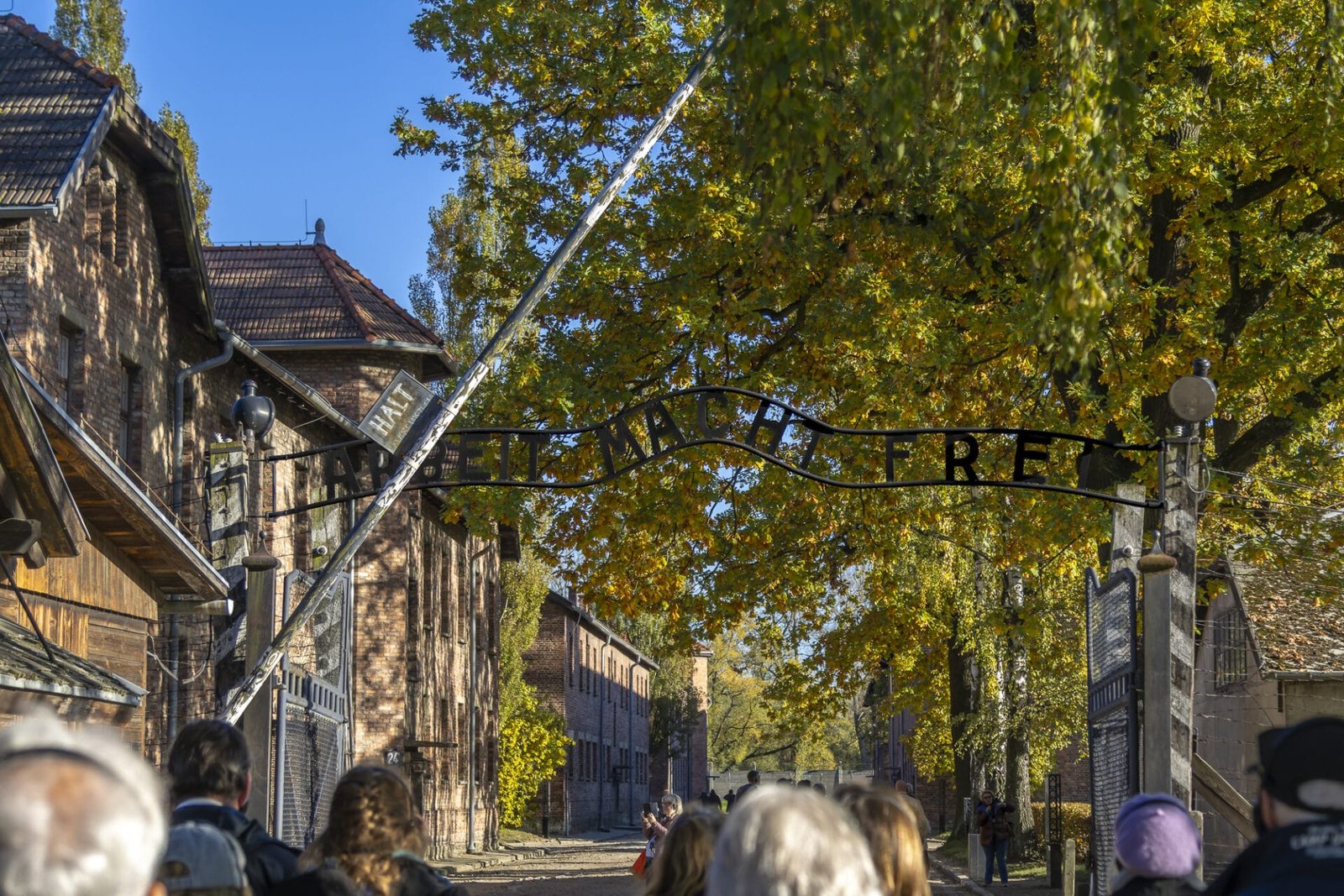
The main gate into the camp has the sign “Arbeit Macht Frei” which translates to “Work Sets You Free”.

There are many signs posted around the camp and I will be showing several of them. Most are self-explanatory.

This barbed wire fence surrounds the entire camp. Note that the barbed wire is not attached directly to the posts, but by way of ceramic insulators. This fence was not just made of barbed wire, but was electrified, also.

Those prisoners that tried to escape were shot. Their bodies were displayed as a warning for other prisoners.


A camp orchestra played marches to facilitate moving and counting of prisoners.

When there was a successful escape, the Germans would bring family members to this place to stand under a sign until the escapee was captured.

This is the main street that runs through Auschwitz. Each building had a specific purpose ranging from extermination, scientific experimentation, or simply housing prisoners. Today, the scene is much different and could be from any city with rows of apartment buildings.

For example, Building, or Block, 4 was for extermination. This block housed the first gas chamber, where thousands of innocent people, mostly Jews, were murdered by the Nazis. Victims were led into the gas chamber under the pretense of being given a shower, only to be killed by Zyklon B gas, and were later burned in the crematorium. Zyklon B is the trade name for a commercial product whose active ingredient is hydrogen cyanide, a highly toxic gas.

This map shows the main origins, ghettos, transit camps, and prisons, from where the Jews and prisoners were deported to Auschwitz.

These signs shows the numbers of various prisoners in Auschwitz.


The electrified barbed wire fence is seen around the entire camp.

These models show the gas chambers and crematorium.


Block 5 contains displays of thousands of personal belongings, like shoes, clothing, eyeglasses, and suitcases that were confiscated from the prisoners. The items on display give a better understanding of the brutality of the Holocaust. (I could not bring myself to photograph these displays.)

These images are drawings by survivor and artist Alfred Kantor. The first drawing depicts new prisoners arriving at the Auschwitz I camp, where they were forced into lines for “selection” or processing by Nazi SS guards. The sign on the left reads “HALT STOJ”, in German and Polish, which was a common warning sign with a skull and crossbones symbol seen throughout the camp perimeter. Kantor created this and other artwork from memory shortly after the Holocaust as a form of testimony, as there were no actual photographs taken inside certain camp areas, such as the gas chambers. His drawings are considered invaluable historical records of the horrific daily reality of concentration camp life.

This image is a drawing that depicts a scene where SS guards are processing new arrivals, who are civilians carrying luggage, likely at a selection point or the entrance area of the camp.

This image is a drawing by former prisoner Władysław Siwek, depicts an interrogation and torture site within Block 11 at Auschwitz. The artwork captures the brutal conditions and abuse prisoners endured during the Holocaust. The drawing shows German SS guards beating and overseeing prisoners, many of whom appear emaciated. The scene in the foreground depicts a prisoner on the ground being struck, while others stand nearby or are forced to sit on a stool. This piece is one of many secretly created by Auschwitz prisoners to document the atrocities and serve as testimony after the war, a deeply dangerous act of resistance.

The image displays a wall of Auschwitz prisoner identification photographs. These photographs were taken as part of the camp administration’s documentation process, primarily for non-Jewish prisoners, including political prisoners. Each picture was part of a set of three different views and included the prisoner’s number, nationality, and reason for internment.

The following are displays of various prisoner tattoos and their placement, categories of prisoners, and replicas of prisoner badges.


The next few signs describe the uses of various other buildings in Auschwitz.


This is one of the guard watchtowers and the concrete perimeter fence. The watchtowers, manned by SS guards, were strategically placed to monitor the fence line and surrounding area. Guards were authorized to shoot any inmate who approached the fence without warning.

The Death Wall at Auschwitz s a reconstructed portion of the original wall where thousands of innocent prisoners, mostly Jews, were executed by the Nazis. The wall was rebuilt after the war to serve as a reminder of the atrocities that took place at the concentration camp.

This memorial plaque relates back to one of our earlier stops regarding Maximilian Kolbe and translates to “16670 AT THIS PLACE, AT THE END OF JULY 1941, DURING ROLL CALL IN BLOCK 14, THE POLISH FRANCISCAN MAXIMILIAN MARIA KOLBE STEPPED FORWARD TO FACE DEATH IN PLACE OF ANOTHER PRISONER.”

As we exit Auschwitz I, we again pass through a section of electrified barbed wire.


We now leave the Auschwitz I camp for Auschwitz II – Birkenau, about 2 miles away.

The main entrance gatehouse of the Auschwitz II-Birkenau was known to prisoners as the “Gate of Death”. The current structure was completed in 1943. The railway spur running through the archway became operational in May 1944 and was used to transport hundreds of thousands of Jews, Poles, Romas, and other victims to the camp, where most were murdered in gas chambers immediately upon arrival.
Newly arrived prisoners were greeted at the camp by Lagerführer SS-Hauptsturmführer Fritzsch. “You have arrived not at a sanatorium but at a German concentration camp in which the only way out is through the chimney. If someone doesn’t like this, he may at once go to the wires. If there are any Jews in this transport, they have no right to live longer than two weeks. If there are any priests, they may live for a month, the rest only three months.” Source: Jan Karcz, Auschwitz-Birkenau State Museum Archive [henceforth A-BSMA], Recollections Fond, vol. 196, p. 118. [REFERENCE]

The camp is completely surrounded by guard houses and electrified barbed wired fences.


These are some of the remaining buildings that housed prisoners.

The bunk houses were not insulated and wind howled through them in the winter. With bunks 3-high, each bunk house was designed to hold many prisoners. However, due to the large number of prisoners in the camp, each bunk was shared with others, increasing the housing capacity several times.

This building held the latrines for the prisoners. At its peak, there were 90,000 prisoners in this camp. Dysentery, an intestinal infection causing severe diarrhea, was rampant in the camp. These were simple pits, no running water. One of the jobs for prisoners was to empty the pits by hand. As bad as it sounds, it was one of the preferred job in the camp for two reasons. First, it was indoors. Although it was not insulated, it was better than being outdoors all day. Second, the smell was so bad the guards rarely entered the building, thus giving the prisoners the chance to take a break without the immediate scrutiny of the guards.

The sun was setting while we were at the camp. I found the contrast of the beautiful sunset against the horror of the guard towers and fence to be challenging. I could imagine the prisoners seeing a similar sunset knowing they would never be free to enjoy it.


As I stated above, this was a long, hard day. Auschwitz is like no other place I’ve ever been. It sucks the life out of you. I give a lot of credit to our tour guide for sharing the stories.
Another quick story before I close this post. My father was a foot soldier in WW II. He landed on the shore of France just after D-Day and fought his way through the Battle of the Bulge, the Ardennes, and other battles, and wound up in Czechoslovakia. He was part of a group that liberated one of the smaller concentration camps. When he saw what was going on, he said, “Now I understand what we’ve been fighting for.” Having visited Auschwitz, I now have a better appreciation of what he was fighting for.
Mark


Leave a Reply