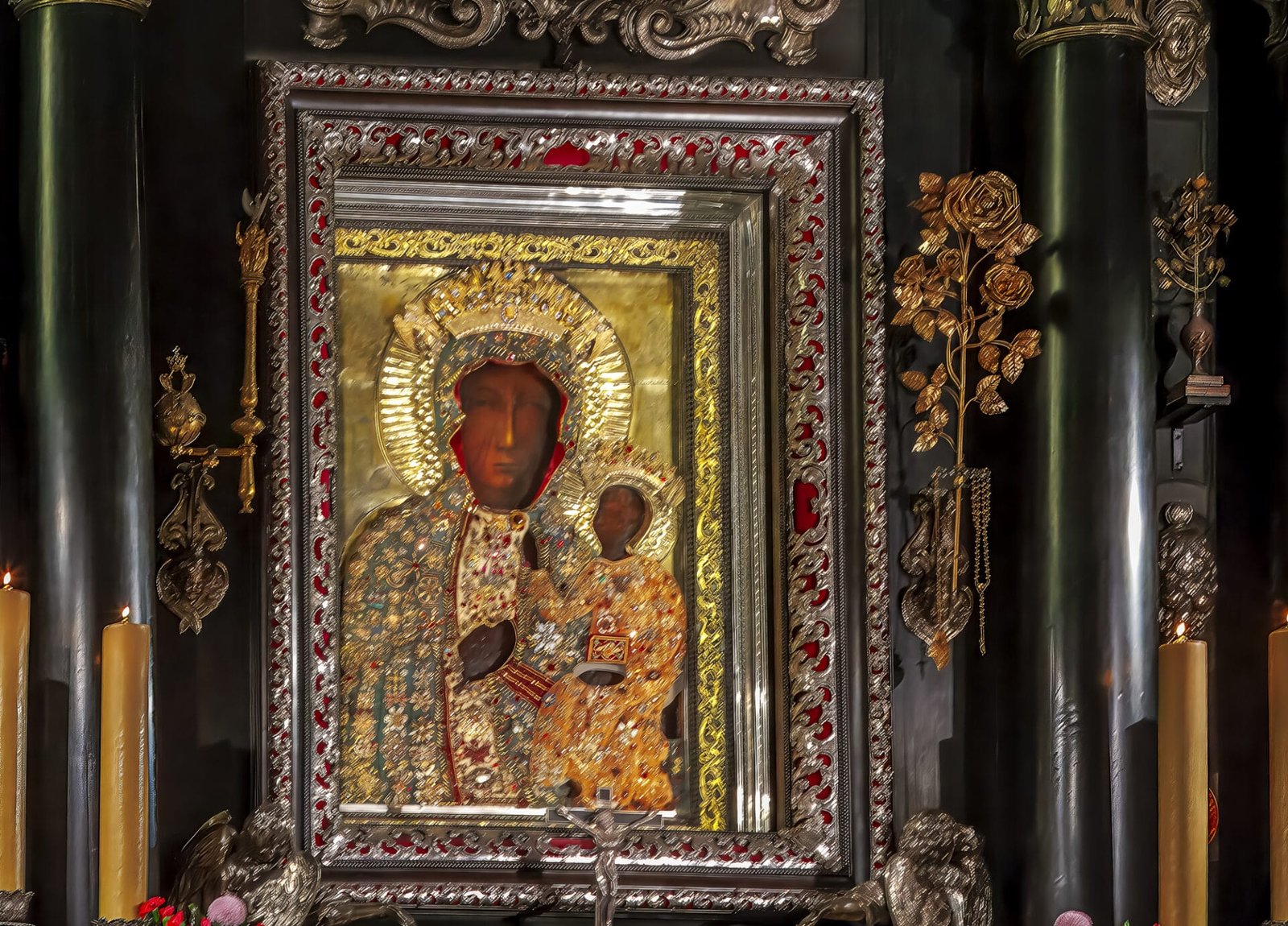
The Black Madonna, or Our Lady of Czestochowa, is an icon of the Blessed Virgin Mary holding the baby Jesus.


All information on Our Lady of Czestochowa comes from the following references. [REFERENCE 1, REFERENCE 2, REFERENCE 3, REFERENCE 4] Other information may have been obtained through AI (Gemini). All translations were done using Google Translate.
About Our Lady of Czestochowa
There is no certain historical information about its origin. According to tradition, the author of the icon is St. Luke the Evangelist, who painted the image on the table used by the Holy Family in Nazareth. Historians, however, believe the history of the painting dates back to the 14th century and its author is an unknown Italian painter.
One difficulty in dating the icon is due to its original image being painted over after being severely damaged by robbers in 1430. The wooden panel backing the painting was broken, and the image slashed. Medieval restorers unfamiliar with the encaustic method found that the paints they applied to the damaged areas “simply sloughed off the image”. (The encaustic method of painting is done with pigmented wax on a substrate, such as a wood panel, with the many layers fused together using heat. [REFERENCE]) Their solution was to erase the original image and repaint it on the original panel.
The oldest description of the image of Our Lady comes from Jan Długosz in “Liber Beneficiorum”: “The image of Mary, the most glorious and noble Virgin and Lady, Queen of the world and our Queen (…) made in a strange and rare manner of painting (…) with a very delightful expression on her face, which penetrates the onlookers with special piety—as if you were looking at a living person.”
Again, according to legend, St. Helena, mother of Emperor Constantine the Great, is said to have brought this Image to Constantinople in the 4th century. There, it was held in great veneration and provided help, especially during times of great distress such as contagious diseases and epidemics. Around the 9th or 10th century, the Image traveled north, eventually resting in the castle of Bełz.
In 1382, during a siege of Bełz Castle, an arrow flew through the chapel window and struck the neck of the Mother of God. To protect the Image from potential further desecration, the Duke decided to transport the Image to Opole in Silesia. When he stopped for a short rest in Częstochowa at the foot of the church on Jasna Góra, the Mother of God made it known to him that she wished to remain there. Therefore, the Duke left the Image at Jasna Góra, entrusting it to the care of the white-clad Pauline Fathers.


In 1430, the Hussites stormed the monastery, plundering the sanctuary. Among the items stolen was the icon. The Hussites tried to get away after putting it in their wagon, but their horses refused to move. They threw the portrait down to the ground, and one of the plunderers drew his sword upon the image and inflicted two deep strikes. When the robber tried to inflict a third strike, he fell to the ground and writhed in agony until his death. The presence of wounds in the painting strengthens the bond of the faithful with the figure of Our Lady of Częstochowa, making her more human, feeling suffering like “ordinary” people.
In this image of a replica of the icon you can clearly see the slash marks on The Madonna’s face.

Although many miracles have been attributed to The Black Madonna, the most significant miracle is the saving of the monastery from the Swedish invasion and siege of 1655, for which she was acclaimed queen and protector of Poland by King John II Casimir Vasa in 1656. The Black Madonna was later credited with defeating a Russian attack in 1920.
There is a power and mystery of this place, to which numerous pilgrims from all over the world have been going for centuries. While praying before the image of Our Lady of Częstochowa, the faithful have experienced numerous miracles and healings.
This image shows a wall of crutches and walking sticks, votive offerings left by pilgrims who reported miraculous healings through the intercession of the Black Madonna icon housed at the monastery.

Since the 18th century, the painting has been decorated with rich dresses. Currently, there are 10 of them, including: diamond, ruby, coral and gold robes. Since 1656, the Black Madonna and Child have had crowns on their heads in reference to the title of Our Lady Queen of Poland.
Jasna Gora Monastery
We approach the monastery by this flag-lined path. The Gate of Peace is visible in the background.

The Gate of Peace features the coat of arms and personal motto of Pope John Paul II. The coat of arms includes a cross and the letter “M” for Mary, reflecting his strong Marian devotion. The motto, “Totus Tuus” (Totally Yours), is inscribed below the shield. The gate was installed in 1982 to commemorate Pope John Paul II’s first pilgrimage to his homeland of Poland after becoming Pope.

This mosaic of the Black Madonna is located just outside the monastery. The Latin phrase at the top, “SUB TUUM PRÆSIDIUM,” translates to “Under Thy Protection”. This is an ancient Christian prayer to the Virgin Mary is believed to be the oldest known extant Marian prayer, dating to around the 3rd century.

This is the altar in the Chapel of the Miraculous Image of the Black Madonna. It is highlighted by two cherubs, columns, and the Pieta near the bottom.

The figure of Christ in this crucifix is made of wood, but the loincloth has been covered with an embroidered velvet band, and a wig of real hair was added after the original cloth and hair were burned in a 15th-century fire.

This is the main altar in the Jasna Gora Monastery.


This image shows the pipe organ in the monastery.


This is an altar piece from one of the smaller altars.

The text translates to “Chapel of the Sacred Heart of Jesus, 17th Century”.


The carved religious relief depicts the meeting of Saint Paul the First Hermit and Saint Anthony the Great in the desert. According to legend, Paul lived as a hermit for over 90 years. When he was near death, the raven that daily brought him a half-loaf of bread arrived with a whole loaf for the two saints to share. The artwork captures this moment, showing the two bearded figures embracing as the raven delivers the bread from heaven.


We attended mass in one of the many smaller chapels. We had to walk through the sacristy to get to the chapel.


Outside the Monastery
This monument just outside the monastery is the Smolensk air disaster memorial plaque. The plaque commemorates the 96 victims of the Polish plane crash near Smolensk, Russia, which occurred on April 10, 2010. The monument honors all victims of the disaster, including the Polish President Lech Kaczyński and his wife Maria Kaczyńska, who are depicted in a small portrait near the top. It depicts a forest scene with candles, symbolizing the souls of the victims lost in the forest near Smolensk.


The Monastery Museum
The monastery museum displayed four sets of images from the rosary. This one depicts scenes from the Joyful Mysteries. From right to left: The Annunciation, The Visitation, The Nativity, The Presentation, and The Finding in the Temple.

The Luminous Mysteries from right to left: The Baptism in the Jordan, The Wedding Feast at Cana, The Proclamation of the Kingdom, The Transfiguration, and The Institution of the Eucharist.

The Sorrowful Mysteries from right to left: The Agony in the Garden, The Scourging at the Pillar, The Crowning with Thorns, Carrying of the Cross, and The Crucifixion.

The Glorious Mysteries from right to left: The Resurrection, The Ascension, The Descent of the Holy Spirit, The Assumption, and The Coronation.


The subject here is St. John the Evangelist. He is shown with an eagle, which in Christian iconography symbolizes the soaring, high-reaching nature of his writings about the divine word. The eagle is pictured resting its head on the book St. John is writing in. He is depicted on a rocky coast, consistent with the tradition that he was exiled to the island of Patmos where he received his divine visions and wrote the Apocalypse.

This shows the setting for the panel with St. John, at the foot of the cross.

The next three images are of special dresses for the icon of Our Lady. When “dressed”, Our Lady and Jesus are almost entirely covered by a decorative, jewel-encrusted covering called a riza or oklad, with only their faces and hands left visible. These metal or textile coverings serve two primary purposes: they protect the painted surface of the icon from smoke and damage from candles and incense, and serve as a sign of honor and veneration for the sacred figures depicted and are used for special occasions.


This last dress is made of amber and diamonds.

This was one of the busiest places we visited on our pilgrimage. The beautiful Jasna Gora Monastery is a splendid home for the highly venerated icon of Our Lady of Czestochowa.
Our next stop will be a more somber one, Auschwitz.
Mark


Leave a Reply