This post will focus on churches in old-town Gdansk. As with some earlier posts, some of the identifications are obtained using Google Gemini and all translations are performed using Google translate.
Royal Chapel
We attended mass in the Royal Chapel situated behind St. Mary’s Church.


These stained glass windows contain symbols of Poland, the Coat of Arms in the left panel, and a shield in the right panel. Note the inscription below the symbols, “Beatus Quitenet”. This translates to “Blessed is He”.

This large dove is set in a stone forming the main altar of the Royal Chapel.


This banner is hung representing the Virgin Mary holding the Christ Child. There is someone off to the side, an unknown saint or monk.

This banner presumably depicts Saint John Berchmans , as named in the embroidery. He had a special devotion to Mary, mother of Jesus. The text translates to a prayer asking the saint to intercede.

St. Mary’s Church
After mass, we proceeded to St. Mary’s Church, also known as the Basilica of the Assumption of the Blessed Virgin Mary. It is one of the most recognizable buildings in Gdansk, towering over old-town.

The Gdansk astronomical clock, located in St. Mary’s church, was constructed between 1464 and 1470. Standing 46 feet tall, it shows an image of Mary holding the baby Jesus. It displays not only time, but the date, calendar of saints, and the position of the sun and moon in relation to the signs of the zodiac. At noon each day, a procession of figures appears, including Adam and Eve, the Three Kings, the Apostles, and Death. It is thought to be the largest wooden clock in the world. And, no, I can’t tell time with this clock.

This shows the detail of the central figure.

This panel contains three parts. The upper and middle sections depict biblical scenes. The left lower section contains the following translated text. “In CHRIST JESUS, may the ends that work through the Chant be strong, Galatians, I now remain here. Hope, Chants, may you be strong in your love, and may you enter your home with boldness.” The right lower section was not clear enough for a translation.


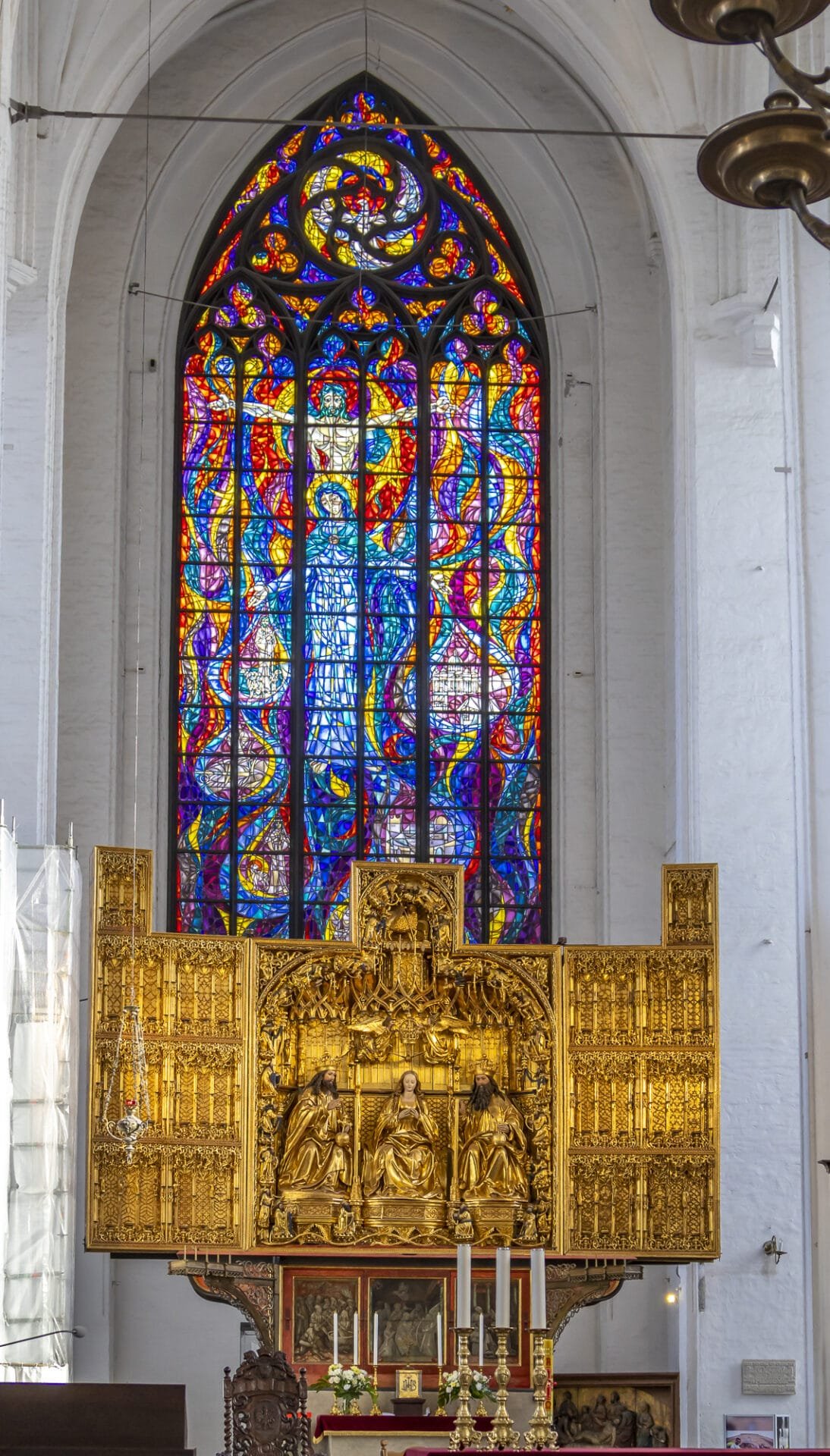
The main altar depicts the coronation of Mary. The stained glass window behind it shows Jesus on the cross with his sorrowful mother Mary.


This crucifix is suspended from the ceiling of St. Mary’s Church. The group depicts the Crucifixion of Christ, with the Virgin Mary and Saint John the Evangelist. Below the cross, a skull and bones are visible, representing Golgotha, the site where Jesus was crucified.

This beautiful pipe organ in the rear of St. Mary’s Church was under some renovation. I had to sneak a peak through a draped fence to get the photo.


This panel depicts the ten commandments. Click on the image to zoom in for more detail. (FYI: You can click on all images in all my posts for an enlarged view.)


This is a copy of the icon known as the Black Madonna of Częstochowa. The text in the ironwork frame above the image translates from Polish to “God-bearer Virgin Mary praised by God”.

This sculpture shows Jesus Christ wearing a crown of thorns, suffering during the Passion.

This altarpiece features a central sculpture of the Virgin Mary and the Christ Child. The wings are painted with various scenes from the lives of saints and Mary.

This ornate doorway leads to the area behind the high altar. Behind the open door, a wrought-iron gate is visible, featuring silhouettes of figures at the top. Beyond the gate is the Veit Stoss altarpiece, carved in the late 1400s, a large Gothic altarpiece and a national treasure. [REFERENCE]

These lists show the history of priests for St. Mary’s Church, dating back to 1344 continuing through 2015 and beyond. Those of us in the US have no concept of this kind of history.

With this, we end our visit to the churches of old-town Gdansk. Now we will turn our attention to the street scenes of old-town.
Mark


Leave a Reply